
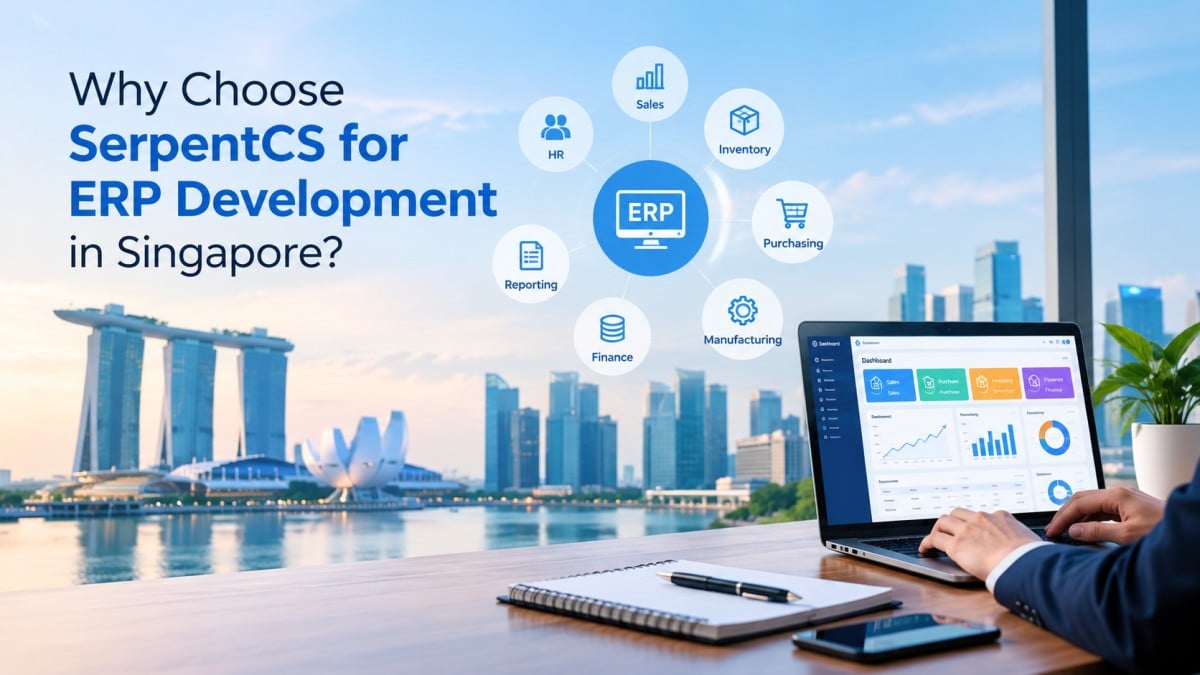
Managing a growing business becomes more challenging when departments rely on separate software, spreadsheets, and manual processes. Delayed reports, inventory errors, and disconnected financial records can affect productivity and business decisions. For companies looking to overcome these challenges, ERP software offers a practical way to bring essential operations together.
ERP development in Singapore enables businesses to build connected systems that simplify daily activities and support long-term growth. Choosing the right development partner is equally important, as the success of an ERP project depends on how well the technology matches actual business requirements.
SerpentCS is an option for companies exploring ERP solutions, workflow customization, and business process automation. Understanding its potential benefits can help businesses make informed decisions about their ERP strategy.
What Is ERP Development?
ERP Development involves creating, customizing, and integrating software that connects different business functions through a centralized system. These functions may include accounting, inventory, purchasing, sales, manufacturing, human resources, and project management.
Instead of maintaining separate records across multiple applications, employees can work with connected business information. This reduces unnecessary data entry and helps teams coordinate their activities more effectively.
For Singapore businesses, ERP software can support improved operational visibility, better resource allocation, and more organized reporting.
Why Do Singapore Businesses Need ERP Solutions?
Singapore’s competitive business environment requires companies to manage resources efficiently while adapting to changing customer expectations. As operations expand, manual processes can become difficult to maintain.
ERP systems can help businesses address several common challenges:
- Disconnected departments: Bring essential business information into a unified platform.
- Inventory management issues: Monitor stock movements, purchasing activities, and warehouse availability.
- Time-consuming administration: Automate repetitive tasks and approval workflows.
- Limited reporting visibility: Access business reports to support informed decisions.
- Growing operational complexity: Manage additional users, locations, and business processes through a scalable system.
A properly planned ERP solution helps organizations establish consistent processes without relying entirely on manual coordination.
Why Choose SerpentCS for ERP Development Services?
Selecting an ERP partner requires evaluating technical capabilities, customization options, implementation planning, and ongoing support.
1. Customized ERP Solutions
Every business follows different procedures for handling orders, managing inventory, approving expenses, and preparing reports. Standard software may not cover every specialized requirement.
Custom ERP Development can address these gaps through tailored dashboards, approval workflows, automated notifications, industry-specific features, and specialized reporting.
SerpentCS can be considered by businesses seeking to evaluate their ERP requirements and identify where customization may improve existing workflows. The objective should be to develop practical functionality without making the system unnecessarily complicated.
2. Business Process Automation
Manual data entry and repetitive administrative work consume valuable employee time. ERP automation can connect activities that would otherwise require multiple applications or repeated communication between departments.
For example, a confirmed purchase order can initiate approval procedures, update purchasing records, and support inventory planning through configured workflows.
By identifying suitable automation opportunities, businesses can reduce avoidable errors and allow employees to focus on more valuable responsibilities.
3. Integration With Existing Software
Companies often use separate applications for accounting, customer relationship management, e-commerce, and warehouse operations. Replacing every system may increase project costs and disrupt established processes.
ERP Development services can connect compatible applications through APIs, connectors, or custom integrations. This helps information move between systems more consistently.
SerpentCS can help businesses assess their integration requirements and determine an appropriate technical approach based on the selected ERP platform and existing infrastructure.
4. Industry-Specific Functionality
ERP requirements differ according to business operations. Manufacturing companies may need production planning, while distributors require accurate inventory tracking and order fulfillment.
ERP solutions can support different industries through features such as:
- Manufacturing: production scheduling, bills of materials, and quality tracking.
- Retail: product management, sales processing, and inventory control.
- Wholesale and distribution: purchasing, warehouse management, and delivery coordination.
- Construction: project costing, procurement, and resource planning.
- Professional services: project tracking, timesheets, and client billing.
Selecting the right features helps businesses avoid investing in functionality they do not need.
5. Scalable and Maintainable Systems
An ERP system should accommodate future business changes without requiring a complete replacement. Additional users, new locations, increased transaction volumes, and evolving reporting requirements can all influence system design.
A well-planned solution considers performance, security, user permissions, data backups, software upgrades, and maintenance from the beginning.
When evaluating SerpentCS, businesses should discuss its proposed architecture, customization approach, project deliverables, and available post-implementation support.
How Does the ERP Development Process Work?
A successful ERP project typically follows a structured process:
- Requirement analysis: Identify business challenges, operational goals, and essential features.
- Solution planning: Select suitable software, modules, and integration requirements.
- Development and configuration: Adapt workflows and implement approved custom features.
- Data migration: Transfer existing business records and verify their accuracy.
- Testing and training: Check essential functions and prepare employees to use the system.
- Deployment and support: Launch the solution, resolve issues, and improve workflows as needed.
Project timelines depend on customization, data quality, integration complexity, and the number of departments involved.
How to Choose the Right ERP Development Partner
Before selecting a provider, evaluate its relevant experience, technical expertise, communication process, and understanding of your industry.
Request a clear project proposal outlining deliverables, estimated costs, timelines, data security responsibilities, and ongoing maintenance arrangements. A demonstration or proof of concept can also help confirm whether the proposed system meets your requirements.
Conclusion
Investing in ERP Development in Singapore can help businesses connect departments, automate routine activities, and improve operational visibility. However, achieving these benefits requires careful planning and a solution that reflects real business needs.
SerpentCS is worth evaluating for organizations exploring ERP Development services, custom workflows, and system integration. Discuss your operational challenges, technical requirements, and future goals with the team to determine whether its proposed ERP solution is suitable for your business.

