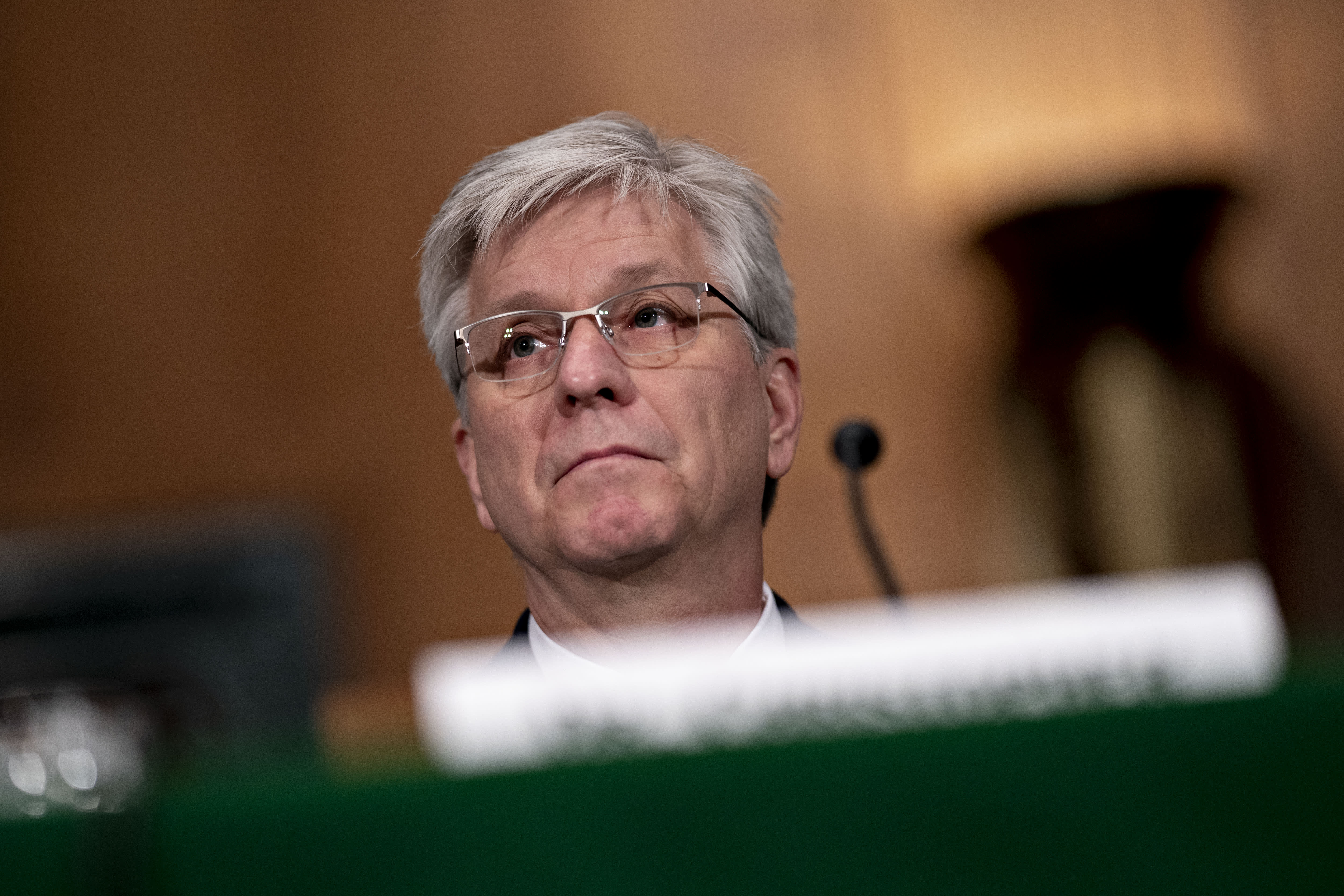
Mary Daly, President of the Federal Reserve Bank of San Francisco, poses after giving a speech on the U.S. economic outlook, in Idaho Falls, Idaho, November 12 2018.
Ann Saphir | Reuters

San Francisco Federal Reserve President Mary Daly acknowledged Wednesday that a near-certain series of interest rate hikes over the coming months could tip the economy into a shallow recession, though she noted that isn’t her expectation.

Responding to the worst inflation the U.S. has seen in more than 40 years, the central bank official said she foresees “an expeditious march” through the year toward benchmark interest rates that would neither stimulate nor repress growth — the “neutral” rate, in Fed parlance.

“Accounting for the risks of being too fast or too slow, I see an expeditious march to neutral by the end of the year as a prudent path,” she said.

The moves, Daly said, would help slow down an overheated economy that now has consumer price inflation running at an 8.5% annual pace.

She cited research from Princeton economist and former Fed vice chair Alan Blinder, who asserted that in 11 previous Fed hiking cycles, seven “were followed by a mild recession or none at all — basically a smooth landing,” she said in remarks at the University of Nevada Las Vegas. “Now, since I’m in Las Vegas, I will offer that I think those are pretty good odds.”

Asked later whether she considered a mild recession to be the equivalent of a soft landing or acceptable outcome, Daly said her outlook is for the economy to slow to “something that looks like below-trend growth, but not tip into negative territory, but could potentially tick into negative territory.”

That likely would mean a shallow recession, unlike those associated with, for instance, the financial crisis of 2008 or the stagflation days of the late 1970s and early ’80s, when then-Chairman Paul Volcker jacked up rates so much that the economy fell into a double-dip recession.

Some Wall Street economists see recession risks rising. Deutsche Bank recently said it sees a near-certainty of negative growth, while Goldman Sachs indicated about a 35% chance over the next two years.

“Recession is one word, but it describes a whole range of outcomes,” Daly said in response to a CNBC question. “It can be a couple of quarters of a tiny bit below zero. That’s a very different beast than something like the financial crisis or the Volcker disinflation period.”

“That’s not something that I’m forecasting or something I think would derail the long-run expansion,” she added.

Markets currently expect the Fed to enact a series of aggressive interest rate hikes between now and the end of the year. Following a 25 basis point, or quarter percentage point, increase in March, the expectation is a series of 50 basis point moves then a slowdown that will take the benchmark fed funds rate to about 2.5% by the end of the year, according to CME Group data.

Earlier in the day, Chicago Fed President Charles Evans said “I’m open to doing 50 basis point increases in order to front-load this a little bit.” St. Louis Fed President James Bullard on Monday said he’d like to move even faster and thinks a 75 basis point move next month would be appropriate, though traders are pricing in no chance of that happening.

For her part, Daly said she doesn’t want the Fed to slam on the brakes too quickly as that could endanger the pandemic-era recovery, which has been strong outside of the historic inflation move.

“If we ease on the brakes by methodically removing accommodation and regularly assessing how much more is needed, we have a good chance of transitioning smoothly and gliding the economy to its long-run sustainable path,” she said.


Get CyberSEO Lite (https://www.cyberseo.net/cyberseo-lite) – a freeware plugin for WordPress to pull full-text RSS articles 📃
Read More

A contractor uses a hammer while working on townhouse under construction at the PulteGroup Metro housing development in Milpitas, California.
David Paul Morris | Bloomberg | Getty Images

Sharply rising mortgage rates are taking their toll on the nation’s homebuilders, as already pricey new construction becomes even less affordable. 

Builder confidence in the market for new single-family homes fell 2 points to 77 in April, according to the National Association of Home Builders/Wells Fargo Housing Market Index. Any reading above 50 is considered positive sentiment, but the reading marks the fourth straight month of declines for the index, which stood at 83 in April 2021.

Of the index’s three components, current sales conditions fell 2 points to 85. Buyer traffic dropped 6 points to 60, and sales expectations in the next six months increased 3 points to 73 following a 10-point drop in March.

“Despite low existing inventory, builders report sales traffic and current sales conditions have declined to their lowest points since last summer as a sharp jump in mortgage rates and persistent supply chain disruptions continue to unsettle the housing market,” said NAHB Chairman Jerry Konter, a builder and developer from Savannah, Georgia.

The average rate on the 30-year fixed mortgage stood at around 3.90% at the beginning of March, and is now up to 5.15%, according to Mortgage News Daily. That is the highest rate in more than a decade. The rate loosely follows the yield on the U.S. 10-year Treasury, which has been on the rise, but is also being impacted as the Federal Reserve pulls out of the mortgage-backed bond market.

Elevated mortgage rates are only exacerbating high prices for both new and existing homes. The median price of a newly built home in February was up over 10% from the year prior.

“The housing market faces an inflection point as an unexpectedly quick rise in interest rates, rising home prices and escalating material costs have significantly decreased housing affordability conditions, particularly in the crucial entry-level market,” said NAHB Chief Economist Robert Dietz.

Regionally, on a three-month moving average, builder sentiment in the Northeast rose 1 point to a reading of 72. In the Midwest it fell 3 points to 69, in the South it fell 2 points to 82 and in the West it fell 1 point to 89.

Get CyberSEO Lite (https://www.cyberseo.net/cyberseo-lite) – a freeware plugin for WordPress to pull full-text RSS articles 📃
Read More

Customers pushing shopping carts shop at a supermarket on April 12, 2022 in San Mateo County, California.
Liu Guanguan | China News Service | Getty Images

Consumers continued to spend in March even as inflation rose to its highest level since late 1981, according to government data released Thursday.

Retail sales climbed 0.5% from the previous month, slightly less than the 0.6% Dow Jones estimate and a deceleration from the upwardly revised 0.8% gain in February.

The move came with inflation rising 1.2% for the month as measured by the consumer price index.

Retail sales data is not adjusted for inflation. Consequently, the biggest gain in sales for the month game at gas stations, which saw an 8.9% increase in sales as gasoline prices rose 18.3% during the period. The sector has seen a 37% sales burst over the past year.

By contrast, online sales slumped sharply, falling 6.4% for the month. General merchandise stores saw a gain of 5.4%, sporting goods and electronics stores both had 3.3% gains, and sales at food and beverage stores along with bars and restaurants rose 1%.

Retail sales broadly rose 6.9% from a year ago, a period during which CPI inflation surged 8.5%, the highest level since December 1981.

In other economic data, initial jobless claims rose to 185,000 for the week ended April 9, an increase of 18,000 from the previous week and above the estimate of 172,000. Continued claims, which run a week behind the headline number, fell by 48,000 to 1.475 million.

Also, inflation continued to hit imports, with prices rising by 2.6%, the largest monthly increase since April 2011, the Bureau of Labor Statistics reported. That was higher even than the 2.2% estimate.

On a 12-month basis, import prices jumped 12.5%, the largest such gain since September 2011.

Correction: The consumer price index rose 1.2% in March. An earlier version misstated the percentage.

Get CyberSEO Lite (https://www.cyberseo.net/cyberseo-lite) – a freeware plugin for WordPress to pull full-text RSS articles 📃
Read More

Getting inflation under control will require raising interest rates at a faster pace than normal even though the pace of price increases probably has peaked, Federal Reserve board member Christopher Waller said Wednesday.

That means the central bank likely will hike short-term rates by half a percentage point, or 50 basis points, at its meeting in May, and possibly follow it up with similar moves in the next several months, Waller told CNBC. The Fed normally increases in 25-basis-point increments. A basis point equals 0.01%.

“I think the data has come in exactly to support that step of policy action if the committee chooses to do so, and gives us the basis for doing it,” he said during a live “Closing Bell” interview with CNBC’s Sara Eisen. “I prefer a front-loading approach, so a 50-basis-point hike in May would be consistent with that, and possibly more in June and July.”

Markets already have almost fully priced that level of increase at next month’s Federal Open Market Committee meeting, as well as the following session in June, according to CME Group data that tracks moves in the fed funds futures market. Pricing for July also is tilting that way, with a 56.5% probability of another 50-basis-point hike.

That means that should the Fed choose to move aggressively, it won’t come as a surprise.

Waller said he thinks the central bank can pull off the tighter policy now because the economy is strong enough to support higher rates. The Fed is looking to raise rates to stave off inflation running at its highest levels in more than 40 years.

“I think we’re going to deal with inflation. We’ve laid out our plans,” he said. “We’re in a position where the economy’s strong, so this is a good time to do aggressive actions because the economy can take it.”

Nevertheless, there is some disagreement over how aggressive FOMC members want to be in the inflation battle.

In March, those favoring a quarter-percentage-point hike held just a tiny majority over those who wanted to double that. Officials through their public statements have offered differing views about how far the Fed should go, with Waller part of a group that wants rates to go past “neutral,” or the point where they are considered neither restrictive nor stimulative. The neutral funds rate now is considered to be around 2.5%.

On the other side of the debate, policymakers including Fed board member Lael Brainard and Chicago Fed President Charles Evans have said in recent days that they would rather get the rate to neutral and then assess what future actions may be needed.

“I think we want to get above neutral certainly by the latter half of the year, and we need to get closer to neutral as soon as possible,” Waller said.

St. Louis Fed President James Bullard told the Financial Times that it’s “fantasy” to think rates can go to neutral and still bring down inflation.

For his part, Waller said he is confident inflation will start coming down, even though the Fed’s powers are limited to control the lagging supply chains associated with the current round of higher prices.

“All we can do is kind of push down demand for these products and take some pressure off the prices that people have to pay for these products,” Waller said. “We can’t produce more wheat, we can’t produce more semiconductors, but we can affect the demand for these products in a way that puts downward pressure and takes some pressure off of inflation.”

Earlier in the day, Treasury Secretary Janet Yellen, a former Fed chair, said of the agency’s board members, “It’s their job to bring inflation down.”

“They have a dual mandate. They will try to maintain strong labor markets while bringing inflation down,” Yellen said during an appearance before the Atlantic Council. “And it has been done in the past. It’s not an impossible combination, but it will require skill and also good luck.”

Get CyberSEO Lite (https://www.cyberseo.net/cyberseo-lite) – a freeware plugin for WordPress to pull full-text RSS articles 📃
Read More

The prices that goods and services producers receive rose in March at the fastest pace since records have been kept, the Bureau of Labor Statistics reported Wednesday.

The producer price index, which measures the prices paid by wholesalers, increased 11.2% from a year ago, the most in a data series going back to November 2010. On a monthly basis, the gauge climbed 1.4%, above the 1.1% Dow Jones estimate and also a record.

Stripping out food, energy and trade services, so-called core PPI rose 0.9% on a monthly basis, nearly double the 0.5% estimate and the biggest monthly gain since January 2021. Core PPI increased 7% on a year-over-year basis.

PPI is considered a forward-looking inflation measure as it tracks prices in the pipeline for goods and services that eventually reach consumers.

Wednesday’s release comes the day after the BLS reported that the consumer price index for March surged 8.5% over the past year, above expectations and the highest reading since December 1981.

On the producer side, prices for final demand goods led with a 2.3% monthly rise, while services prices gained 0.9%, up sharply from the 0.3% February increase. Goods inflation has outstripped services during the Covid pandemic, but March’s numbers indicate that services are now catching up as consumer demand shifts.

Energy prices were the biggest gainer for the month, rising 5.7%, while food costs increased 2.4%.

Swelling inflation has prompted the Federal Reserve to begin tightening monetary policy.

In March, the Fed increased its benchmark short-term borrowing rate by 0.25 percentage point as the first step in what is expected to be a series of hikes through the year. Markets are pricing in an almost certainty that the central bank will double that move at its May meeting, and will keep going until the fed funds rate hits about 2.5% by the end of the year.

Markets initially showed no reaction to the PPI news, with stock market futures hovering around flat and Treasury yields also little changed.

Get CyberSEO Lite (https://www.cyberseo.net/cyberseo-lite) – a freeware plugin for WordPress to pull full-text RSS articles 📃
Read More

Prices that consumers pay for everyday items surged in March to their highest levels since the early days of the Reagan administration, according to Labor Department data released Tuesday.

The consumer price index, which measures a wide-ranging basket of goods and services, jumped 8.5% from a year ago on an unadjusted basis, above even the already elevated Dow Jones estimate for 8.4%.

Excluding food and energy, so-called core CPI increased 6.5% on a 12-month basis, in line with the expectation. However, there were signs that core inflation appeared to be ebbing, as it rose just 0.3% for the month, less than the 0.5% estimate. That in turn sparked some hope that inflation overall was easing and that March might represent the peak.

Markets reacted positively to the report as stocks rose and government bond yields declined.

“The big news in the March report was that core price pressures finally appear to be moderating,” wrote Andrew Hunter, senior U.S. economist at Capital Economics. Hunter said he thinks the March increase will “mark the peak” for inflation as year-over-year comparisons drive the numbers lower and energy prices subside.

Federal Reserve Governor Lael Brainard said the slowing increase in core CPI is a “welcome” development in the effort to bring down inflation.

“”I’ll be looking to see whether we continue to see moderation in the months ahead,” Brainard told the Wall Street Journal.

The data reflected price rises not seen in the U.S. since the stagflation days of the late 1970s and early ’80s. March’s headline reading in fact was the highest since December 1981. Core inflation was the hottest since August 1982.

Due to the surge in inflation, worker wages, despite rising 5.6% from a year ago, weren’t keeping pace with the cost of living. Real average hourly earnings posted a seasonally adjusted 0.8% decline for the month, according to a separate Bureau of Labor Statistics report.

The inability of wages to keep up with costs could add to inflation pressures.

The Atlanta Federal Reserve wage tracker for March indicated gains of another 6% which is “symptomatic of inflation pressures continuing to broaden,” said Brian Coulton, chief economist at Fitch Ratings. Coulton pointed out that the core inflation deceleration was due largely to a drop in auto prices, while other prices continued to show increases.

Shelter costs, which make up about one-third of the CPI weighting, increased another 0.5% on the month, making the 12-month gain a blistering 5%, the highest since May 1991.

To combat inflation, the Fed has begun raising interest rates and is expected to continue doing so through the remainder of the year and into 2023. The last time prices were this high, the Fed raised its benchmark rate to nearly 20%, pulling the economy into a recession that finally defeated inflation.

Economists generally don’t expect a recession this time around, though many on Wall Street are raising the probability of a downturn.

“Overall, this report is encouraging, at the margin, though it is far too soon to be sure that the next few core prints will be as low; much depends on the path of used vehicle prices, which is very hard to forecast with confidence,” wrote Ian Shepherdson, chief economist at Pantheon Macroeconomics. “We’re sure they will fall, but the speed of the decline is what matters.”

Price increases came from many of the usual culprits.

Food rose 1% for the month and 8.8% over the year, as prices for goods such as rice, ground beef, citrus fruits and fresh vegetables all posted gains of more than 2% in March. Energy prices were up 11% and 32%, respectively, as gasoline prices popped 18.3% for the month, boosted by the war in Ukraine and the pressure it is exerting on supply.

One sector that has been a major driver in the inflation burst subsided in March. Used car and truck prices declined 3.8% for the month, though they are still up 35.3% on the year. Also, commodity prices excluding food and energy fell by 0.4%.

Those declines, however, were offset by gains in clothing, services excluding energy and medical care, each of which increased 0.6% for the month. Transportation services also rose 2%, bringing its 12-month gain to 7.7%.

In a sign of economic recovery from a sector hard-hit during the Covid pandemic, airline fares jumped by 10.7% in the month and were up 23.6% from a year ago.

Get CyberSEO Lite (https://www.cyberseo.net/cyberseo-lite) – a freeware plugin for WordPress to pull full-text RSS articles 📃
Read More

A customer selects food from a freezer at a supermarket on January 12, 2022 in New York City.
Liao Pan | China News Service | Getty Images

Consumer price inflation in March is expected to have spiked the most since December 1981, driven by higher food costs, rising rents and runaway energy prices.

The consumer price index will be released Tuesday at 8:30 a.m. ET, and economists expect a monthly jump of 1.1% and a year-over-year gain of 8.4%, according to Dow Jones. That compares with February’s increase of 0.8%, or 7.9% year over year, the highest since early 1982.

“It’s going to be ugly,” said Mark Zandi, chief economist at Moody’s Analytics. “It’s a perfect storm — Russian invasion, surging oil prices, China locking down, further disruptions to supply chains, wage growth accelerating, unfilled positions. Just a kind of scrambled mess leading to painfully high inflation. We’re struggling through two massive global supply shocks. It would be hard to imagine we didn’t suffer higher inflation.”

Core inflation, excluding food and energy, is expected to rise a half percent — the same as February — with a year-over-year gain of 6.6%, up from 6.4%, according to Dow Jones.

“The good news is it does look like it will be the peak because of oil prices,” said Diane Swonk, chief economist at Grant Thornton. Oil prices surged shortly after Russia invaded Ukraine in late February, reaching a high for West Texas Intermediate oil futures of $130.50 per barrel in early March. That price has fallen to about $94 per barrel Monday.

Gasoline prices also surged, reaching a national average of $4.33 per gallon of unleaded on March 11, according to AAA. That price Monday was $4.11 per gallon.

“The problem for the Fed is the broadening of inflation from goods into services and also because used car prices might be picking up again,” said Swonk. “The supply chain issues aren’t going away. They’re getting worse.”

Just on base effects, economists say this month or next month could be the peak for inflation. Zandi projects headline CPI will fall to 4.9% by the end of this year.

The Federal Reserve is expected to tighten policy aggressively to rein in the hottest inflation in four decades. Markets expect a half-point hike in May, and economists say a hot inflation report could also bring a half-point hike in June.

“The Fed’s on track. It’s at least a half-percent hike, and the balance sheet reductions starting out,” he said.

The Fed first raised interest rates by a quarter point in March, after cutting the fed funds target rate to zero in early 2020.

Tom Simons, money market economist at Jefferies, expects to see the Fed raise rates by 50 basis points at its May 3 meeting, and he said the CPI should not change that. “If it comes in dramatically higher than expected, which I don’t think it will, it’s going to start talk of a 75-basis-point hike, or an intermeeting hike,” he said. “That’s pretty much nonsense in my opinion.” A basis point equals 0.01%.

Simons said energy prices in CPI are expected to jump 18% in March. “That first half of March was particularly acute post-Russian invasion. Food prices are a similar story but not nearly to the same extent. … Housing again is going to be a pretty significant factor,” he said.

He expects owners’ equivalent rent, or the cost of a home in CPI, to rise about 0.5%, while rents should rise 0.6% month over month. Shelter costs are one area that is expected to keep rising. That would put shelter, which is a third of CPI, up 4.6% year over year.

Swonk said the increases to shelter costs are the highest since early 1990, and they could continue to rise. “I think there’s a risk it comes in on the hot side,” she said.

Get CyberSEO Lite (https://www.cyberseo.net/cyberseo-lite) – a freeware plugin for WordPress to pull full-text RSS articles 📃
Read More

White House press secretary Jen Psaki answers questions during the daily briefing on March 09, 2022 in Washington, DC. Psaki answered a range of questions related primarily to Russia’s invasion of Ukraine.
Win Mcnamee | Getty Images

WASHINGTON — The Biden administration is bracing for Tuesday’s key consumer inflation report to show that the prices Americans pay soared in March, as Russia’s assault on Ukraine caused energy prices to jump.

White House press secretary Jen Psaki said Monday that the Labor Department’s previous report — which showed prices rising at a dramatic rate in February — failed to include the majority of the jump in oil and gas costs caused by the Kremlin’s unprovoked invasion.

“We expect March CPI headline inflation to be extraordinarily elevated due to Putin’s price hike,” Psaki told reporters.

“We expect a large difference between core and headline inflation,” she continued, “reflecting the global disruptions in energy and food markets.”

The Bureau of Labor Statistics on Tuesday will issue its March update to the consumer price index, or CPI. The CPI is the department’s tool for measuring inflation in a basket of goods and services that the average American would buy — ranging from eggs and milk to cellphones and unleaded gasoline.

Economists consider two versions of the CPI data: The headline number that includes all prices consumers face, and a so-called core CPI that excludes often volatile food and energy price fluctuations.

The White House says it anticipates a wider-than-normal disparity between the headline and core readings because of an abnormal increase in gas prices that occurred last month. The price for a gallon of regular unleaded gasoline hit a record high of $4.33 on March 11, according to the American Automobile Association.

That price has since slid to $4.11 a gallon, according to AAA.

“At times, gas prices were more than one dollar above pre-invasion levels, so that roughly 25% increase in gas prices will drive tomorrow’s inflation reading,” Psaki said.

Labor Department data has for several months shown that year-over-year price jumps have been hitting levels not seen since Ronald Reagan was in the Oval Office. The February reading showed benchmark consumer inflation index rose 7.9% over the last 12 months, the highest level since January 1982.

The March report is due out on Tuesday at 8:30 a.m. ET.

The press secretary noted that President Joe Biden has taken several steps to help lower energy costs, including a move to release about 1 million barrels of oil a day from the nation’s Strategic Petroleum Reserve.

On the final day of March, Biden blamed Russian President Vladimir Putin for the most recent spike in energy costs.

“Many people are no longer buying Russian oil around the world. I banned Russian-imported oil here in America, Republicans and Democrats in Congress called for it and support it. It was the right thing to do,” Biden said on March 31.

“But as I said at the time, it’s going to come with a cost,” the president added. “As Russian oil comes off the global market, supply of oil drops and prices are rising. Now Putin’s price hike is hitting Americans at the pump.”

Stalled legislation — key components of the president’s Build Back Better agenda — backed by the White House and congressional Democrats could also help cut child-care and health-care costs, Psaki added.

Get CyberSEO Lite (https://www.cyberseo.net/cyberseo-lite) – a freeware plugin for WordPress to pull full-text RSS articles 📃
Read More

Moyo Studio | E+ | Getty Images

As the coronavirus pandemic wears on and government aid sent at the beginning of the crisis runs out, Americans are feeling the impact of tight budgets.

One-quarter of Americans said that they felt financially stressed all the time last year, according to a CNBC + Acorns Invest in You survey, conducted by Momentive. The online survey of nearly 4,000 adults was conducted March 23-24.  

Another 41% said they feel financially stressed sometimes, and 33% said they felt rarely or never financially stressed in the last year.

More from Invest in You:
Inflation could mean a big heating bill this winter. How to prepare
As inflation rises, where to find opportunities to make and save money
Your financial wrap-up: 4 savvy money moves to make before year-end

The main cause of financial stress has been rising prices, as Americans grapple with the highest inflation in 40 years. Many people were unprepared to deal with these price hikes, said Susan Greenhalgh, an accredited financial counselor who runs Mind Your Money in Hope, Rhode Island.

“We don’t really know how to deal with them, and how to address them,” she said, adding that having your eyes focused on your spending is always a good strategy.

Shifting the budget

Financial stress appears to be hitting those with lower incomes the hardest.

Nearly 60% of people who had a household income of less than $50,000 said they’re under more financial stress now than they were a year ago, the survey found.

That’s compared with 53% of people in households making between $50,000 and $100,000 annually and 45% of people making more than $100,000 who said the same thing.

Those who are struggling the most may have to make some serious choices with their finances, said Tania Brown, an Atlanta-based certified financial planner and founder of FinanciallyConfidentMom.com. She recommends prioritizing the essentials before anything else — that includes, rent, food, utilities and basic medical expenses.

“In this environment, legitimately other bills may have to go by the wayside,” she said. “Depending on your income, you’re fighting just to keep your home.”

She also suggested reaching out to creditors for help and looking for programs that may lower the cost of utilities depending on income. It may also be a time to look at other monthly expenses and subscriptions to see what can be reduced or cut, including the cost of internet or cable.

You have to be a lot more proactive in reviewing your budget.
Tania Brown
founder of FinanciallyConfidentMom.com

There are also a few ways to find deals on gas, such as using GasBuddy, carpooling or scheduling errands all at once to avoid making multiple trips.

People can also make other changes to bring down bills, such as using heat and air conditioning less, or opting for meals without meat.

In addition, if a family must dip into their emergency savings to stay afloat right now, Brown said they shouldn’t feel bad — the point of having such an account is for such situations.

“You’re using it as intended,” she said.

Prices may keep rising

To be sure, most Americans aren’t feeling as stressed all the time about the pressures of inflation. Still, they might be in a very different financial situation now due to rising prices — some 52% said they’re under more financial stress now than they were a year ago.

Because the cost of goods is likely to continue to rise in the short term, people should be checking in with their budgets on a more frequent basis because of how quickly prices are changing, said Brown.

“You have to be a lot more proactive in reviewing your budget and actually looking at what you spent last month because the numbers may change,” she said. “Give yourself a lot more wiggle room.”

That may mean saving less for a few months, rethinking your short-term financial goals or even looking for a raise or a job that will pay you more.

SIGN UP: Money 101 is an 8-week learning course to financial freedom, delivered weekly to your inbox. For the Spanish version Dinero 101, click here.

CHECK OUT: 74-year-old retiree is now a model: ‘You don’t have to fade into the background’ with Acorns+CNBC

Disclosure: NBCUniversal and Comcast Ventures are investors in Acorns.

Get CyberSEO Lite (https://www.cyberseo.net/cyberseo-lite) – a freeware plugin for WordPress to pull full-text RSS articles 📃
Read More

A motorist pumps gas at a Valero station along Encinitas Blvd in Encinitas, CA on Tuesday, April 5, 2022.
Sandy Huffaker | The Washington Post | Getty Images

Worries are increasing over inflation, with new Federal Reserve data showing a record-high fear over surging prices.

Consumers now see inflation hitting 6.6% over the next year, according to the New York Fed’s survey in March, released Monday. That’s a 10% increase in the median expectation just over the past month and the highest level in a series that dates to 2013.

The survey showed that median expectations over a three-year span actually decreased by 0.1 percentage point to 3.7%, largely due to a declining outlook from those with annual household incomes below $50,000.

However, uncertainty about inflation over both the one- and three-year spans showed record highs.

Household spending expectations rose sharply, climbing 1.3 percentage points to 7.7%, also a new series high.

The data comes a day before the release of the March consumer price index, which is expected to show prices rising at an 8.4% pace over the past 12 months, according to Dow Jones estimates. If that forecast is accurate, it would be the highest number since December 1981.

To fight inflation, the Fed last month approved its first interest rate hike in more than three years. Additional increases are expected throughout the year as inflation runs well above the central bank’s longstanding target of 2%.

Consumers see the fastest increases coming from rent (10.2%), which accounts for about one-third of the CPI. Medical care, food and gasoline are expected to jump by 9.6%. The outlook for college costs decreased by 0.5 percentage point to 8.5%.

Anticipated wage gains held steady at 3%, while 36.2% said they think the unemployment rate will increase over the next year, the highest level since February 2021. Unemployment is currently at 3.6%, just above where it was prior to the Covid pandemic though labor force participation remains 1 percentage point lower.

Anxiety increased slightly over job stability, with the probability of losing one’s job over the next year rising to 11.1%, a 0.3 percentage point gain that is still well below the 13.8% pre-pandemic level.

Get CyberSEO Lite (https://www.cyberseo.net/cyberseo-lite) – a freeware plugin for WordPress to pull full-text RSS articles 📃
Read More