
Is the U.S. economy showing no signs of a recession or hurtling inescapably towards one? Is it in fact already in one? 

More than a month after the country recorded two successive quarters of economic contraction, it still depends who you ask. 

Steve Hanke, professor of applied economics at Johns Hopkins University, believes the U.S. is headed for a “whopper” of a recession in 2023. While Stephen Roach of Yale University agrees it will take a “miracle” for the U.S. to avoid a recession next year — but it won’t be as bad as the downturn of the early 1980s. 

Yet the Nobel Prize-winning economist Richard Thaler says he doesn’t see “anything that resembles a recession” in the U.S. right now, pointing to recent low unemployment, high job vacancies, and the fact that the economy is growing — just not as fast as prices

And market participants are similarly divided. 

Liz Ann Sonders, chief investment strategist at Charles Schwab, says a recession is more likely than a soft landing for the U.S. economy right now, although it may be a rotational recession that hits the economy in pockets. 

While Steen Jakobsen, chief investment officer at Saxo Bank, was clear in a recent interview with CNBC: the U.S. is not heading for a recession in nominal terms, even if it is in real terms.

Recent surveys reflect the split. A Reuters poll of economists in late August put the chance of a U.S. recession within a year at 45% (with most saying one would be short and shallow), and a Bloomberg survey put the probability of a downturn at 47.5%. 

Mixed signals 

So why the discrepancy? It depends what you focus on: gross domestic product (GDP), or the jobs market.

U.S. GDP declined by 0.9% year-on-year in the second quarter and by 1.6% in the first, meeting the traditional definition of a recession. The slump in growth was driven by a number of factors including falling inventories, investment and government spending. Inflation-adjusted personal income and saving rates also fell.

However, in the U.S. a recession is officially declared by the National Bureau of Economic Research, which likely won’t make a judgment on the period in question for some time.

What makes this time different from every other six-month period of negative GDP since 1947 has been continued strength in the jobs market. 

The closely-watched nonfarm payrolls data for August, released Friday, showed nonfarm payrolls increased by 315,000 — a solid rise, but the lowest monthly gain since April 2021.

It added to other recent releases which have shown a slowdown in private payroll growth, but a much higher rate of new job openings than expected.

William Foster, senior credit officer at Moody’s, said jobs-versus-GDP continued to be the big debate among economic commentators, against a backdrop of the U.S Federal Reserve changing quickly from an accommodative monetary policy — where it adds to the money supply to boost the economy — to a restrictive one, involving interest rate hikes in order to tackle inflation, which hit 8.5% in July.

“We’re coming out of an extraordinary period that’s not been seen before in history,” Foster told CNBC by phone. 

When making its decision, the National Bureau of Economic Research looks at real income for households, real spending, industrial production and the labor market and unemployment — and those variables aren’t giving clear recession signals, Foster said. 

“The jobs market is still struggling to hire people, particularly in the services sector,” he said.

Wider indicators

Foster also noted that households were still spending relatively strongly, albeit at a slower rate of growth, enabled by the period of accumulation of household savings during the pandemic.

However, at the recent Ambrosetti Forum in Italy, economist Joseph Stiglitz told CNBC he was concerned about the fall in real wages workers were experiencing despite the tight labor market.

As well as disagreeing on which indicators to focus on, commentators are also split on what certain sectors are showing.

Investor Peter Boockvar says the latest data on housing and manufacturing show why the U.S. will not be able to avoid a recession, with the National Association of Home Builders/Wells Fargo Housing Market Index dropping into negative territory in August.

But according to Saxo Bank’s Jakobsen: “We still have double digit increases in the rental market. That is not going to create a recession.”

“Simply, people have enough money on the balance sheet to buy an apartment and rent it out and make 20 to 30%. So [a recession] is not going to happen.”

Volatile times

There are broader reasons for the current level of debate too, said Alexander Nutzenadel, professor of social and economic history at the Humboldt University of Berlin.

“We live in a period of multiple shocks – from Covid 19 over energy prices to political deglobalization – which make predictions extremely difficult,” he told CNBC by email. 

This means the economic performance of a highly developed country such as the U.S. depends heavily on external factors. 

The current situation of “stagflation” — when high inflation and economic stagnation occur simultaneously — is historically rare, he continued, though not completely unprecedented. 

“We had a similar moment in the 1970s, but from this experience we know that monetary policy has enormous difficulties to find the right balance between fighting inflation and preventing a recession.”

Finally, he noted that the economics profession had become “much more diverse” in recent years.

“There is no ‘mainstream economics’ anymore, everything has become controversial, including theory, data and methods,” Nutzenadel said.

The very practice of having a recession officially declared by the National Bureau of Economic Research has recently been questioned by some, with Tomas Philipson, professor of public policy studies at the University of Chicago, recently asking: “Why do we let an academic group decide? We should have an objective definition, not the opinion of an academic committee.”

In any case, Philipson concluded, “What really matters is paychecks aren’t reaching as far. What you call it is less relevant.”

— CNBC’s Jeff Cox contributed to this report.

Get CyberSEO Lite (https://www.cyberseo.net/cyberseo-lite) – a freeware full-text RSS article import plugin for WordPress.

Read More

Commuters arrive at Grand Central station during morning rush hour in New York, Nov. 18, 2021.
Jeenah Moon | Bloomberg | Getty Images

The August jobs report showed the U.S. unemployment rate rise across the board. Meanwhile, Black workers marked the only demographic to see their labor force participation fall.

The unemployment rate rose 0.2 percentage point to 3.7% in August, according to data released Friday by the U.S. Bureau of Labor Statistics. Nonfarm payrolls came in at 315,000 and fell in line with estimates of 318,000.

While all demographic groups saw the unemployment rate tick up slightly, it rose at a sharper pace for both Hispanic and Black workers to 4.5% and 6.4%, respectively, from 3.9% and 6% in July.

However, Black workers marked the only group that saw labor force participation decline, while their employment-population ratio, which measures what percentage of the population holds a job, also fell.

“There is some volatility in these numbers but seeing a downward trend in employment and participation is worrisome,” said Elise Gould, senior economist with the Economic Policy Institute.

For August, Black labor force participation fell to 61.8% from 62% in July, while the employment-to-population ratio dipped to 57.9% from 58.3%

William Spriggs, chief economist at the AFL-CIO, said that looking at Black workers is one way to gauge what’s really happening among employers.

Black workers across the board face more discrimination than many other groups, which could be one explanation, Spriggs said. A potential slowdown in hiring — as evident through this week’s ADP private payrolls data — could also be contributing to the results.

“When firms slow their hiring rate, that hit Black workers immediately because they’re already in line the longest to try and find a job,” Spriggs said. “What’s happened is the queue’s just gotten longer so the discouraged worker effect is much more acute for Black workers.”

While it’s too early to assign a specific cause to the declining labor force participation among Black workers, Gould said the continued downward trend in recent months may signal something other than “a statistical anomaly.”

That said, the Federal Reserve’s campaign to quickly raise rates to tame surging prices may be causing more damage to the labor market, which tends to appear among historically disadvantaged groups like Black workers.

“Black workers are beginning to feel the brunt of it in a disparate fashion,” said Michelle Holder, a distinguished senior fellow at Washington Center for Equitable Growth. “Now, this is one report, but I pretty much believe that this is going to be the pattern over the next few months, particularly if the Fed continues to aggressively implement its approach.”

Like others, Holder agrees that it’s too early to attribute a cause to the decline in Black labor force participation, but she did call attention to rising unemployment among Black female workers.

The group saw its unemployment rate rise from 5.3% in July to 5.9%. In comparison, white female workers saw their unemployment rate tick up to 2.8% from 2.6%.

Hispanic female workers also experienced a sharp increase in their unemployment rate, rising to 4.3% from 3.2% in the prior month.

While the jobless rate did rise at a faster clip among Hispanic workers compared to white workers and the overall jobs market, that group’s labor force participation rate and employment trend seem to mimic the broader market, Gould said.

“We’re seeing this rise in unemployment as accompanied by a significant increase in participation and then an uptick as well in employment,” she said. “I think that’s a hopeful sign. The fact that the unemployment rate moves up is not a troubling thing on its own.”

CNBC’s Gabriel Cortes contributed to this report.

Get CyberSEO Lite (https://www.cyberseo.net/cyberseo-lite) – a freeware full-text RSS article import plugin for WordPress.

Read More

“Quiet quitting” is having a moment.

The trend of employees choosing to not go above and beyond their jobs in ways that include refusing to answer emails during evenings or weekends, or skipping extra assignments that fall outside their core duties, is catching on, especially among Gen Zers.

Zaid Khan, 24, an engineer from New York, popularized this trend with his viral Tiktok video in July. 

“You are still performing your duties, but you are no longer subscribing to the hustle culture mentally that work has to be our life,” Khan says in his video. “The reality is, it’s not, and your worth as a person is not defined by your labor.”

In the U.S., quiet quitting could also be a backlash to so-called hustle culture — the 24/7 startup grind popularized by figures like Gary Vaynerchuk and others.

“Quiet quitting is an antidote to hustle culture,” said Nadia De Ala, founder of Real You Leadership, who “quietly quit” her job about five years ago. “It is almost direct resistance and disruption of hustle culture. And I think it’s exciting that more people are doing it.”

Last year, the Great Resignation dominated the economic news cycle. Now, during the second half of 2022, it’s the quiet quitting trend that’s gaining momentum at a time when the rate of U.S. productivity is raising some concern. Data on U.S. worker productivity posted its biggest annual drop in the second quarter. 

So, why is this trend on the rise? Watch the video above to learn whether quiet quitting is hurting the U.S. economy and how it’s being seen as part of the Great Resignation narrative.

Get CyberSEO Lite (https://www.cyberseo.net/cyberseo-lite) – a freeware full-text RSS article import plugin for WordPress.

Read More

Commuters arrive at Grand Central station during morning rush hour in New York, Nov. 18, 2021.
Jeenah Moon | Bloomberg | Getty Images

The August jobs report showed the U.S. unemployment rate rise across the board. Meanwhile, Black workers marked the only demographic to see their labor force participation fall.

The unemployment rate rose 0.2 percentage point to 3.7% in August, according to data released Friday by the U.S. Bureau of Labor Statistics. Nonfarm payrolls came in at 315,000 and fell in line with estimates of 318,000.

While all demographic groups saw the unemployment rate tick up slightly, it rose at a sharper pace for both Hispanic and Black workers to 4.5% and 6.4%, respectively, from 3.9% and 6% in July.

However, Black workers marked the only group that saw labor force participation decline, while the group’s employment-population ratio, which measures what percentage of the population holds a job, also fell.

“There is some volatility in these numbers but seeing a downward trend in employment and participation is worrisome,” said Elise Gould, senior economist with the Economic Policy Institute.

For August, Black labor force participation fell to 61.8% from 62% in July, while the employment to population ratio dipped to 57.9% from 58.3%

William Spriggs, chief economist to the AFL-CIO, said that looking at Black workers is one way to gauge and understand what’s really happening among employers.

Black workers across the board face more discrimination than many other groups, which could be one explanation, he said. A potential slowdown in hiring — as evident through this week’s ADP private payrolls data — could also be a contributor to these results.

“When firms slow their hiring rate, that hit Black workers immediately because they’re already in line the longest to try and find a job,” Spriggs said. “What’s happened is the queue’s just gotten longer so the discouraged worker effect is much more acute for Black workers.

While it’s too early to assign a specific cause to the declining labor force participation among Black workers, Gould said the continued downward trend in recent months may signal something other than “a statistical anomaly.”

That said, the Federal Reserve’s campaign to quickly raise rates to tame surging prices may be causing more damage to the labor market, which tends to appear among historically disadvantaged groups like Black workers.

“Black workers are beginning to feel the brunt of it in a disparate fashion,” said Michelle Holder, a distinguished senior fellow at Washington Center for Equitable Growth. “Now, this is one report, but I pretty much believe that this is going to be the pattern over the next few months, particularly if the Fed continues to aggressively implement its approach.”

Like others, Holder agrees that it’s too early to attribute a cause to the decline in Black labor force participation, but called attention to rising unemployment among Black female workers.

The group saw its unemployment rate rise from 5.3% in July to 5.9%. In comparison, white female workers saw their unemployment rate tick up to 2.8% from 2.6%.

Hispanic female workers also experienced a sharp increase in their unemployment rate, rising to 4.3% from 3.2% in July.

While the unemployment rate did rise at a faster clip among Hispanic workers compared to white workers and the overall jobs market, the group’s labor force participation rate and employment trend seem to mimic the broader market, Gould said.

“We’re seeing this rise in unemployment as accompanied by a significant increase in participation and then uptake as well in employment,” she said. “I think that’s a hopeful sign. The fact that the unemployment rate moves up is not a troubling thing on its own.”

CNBC’s Gabriel Cortes contributed to this report.

Get CyberSEO Lite (https://www.cyberseo.net/cyberseo-lite) – a freeware full-text RSS article import plugin for WordPress.

Read More

The U.S. economy added another 315,000 payrolls in August, with jobs growth slowing overall but still widespread throughout the economy.

The economy saw growth in all the key sectors and subsectors in August, led by a gain of 68,000 jobs in professional and business services.

“The market will like the broad-based gains in jobs as both goods-producing and services jobs rose in August,” said Jeffrey Roach, the chief economist for LPL Financial.

The strongest areas within professional and business services include computer systems design, management and technical consulting, and architectural and engineering. The sector has now added 1.1 million jobs over the past 12 months, according to the U.S. Bureau of Labor Statistics.

Health care came in second for the month, with 48,200 jobs added. If health-care jobs were added to education and social services, as some economists do, that broad sector would have matched the 68,000 gain by professional and business services.

Retail trade was another bright spot, growing by 44,000 jobs. That was an acceleration from the 29,100 jobs added in July.

Even though job growth was positive across the board, it was significantly slower in some areas. Leisure and hospitality, for example, added 31,000 jobs in August after growing by 95,000 in July. The sector is still 1.2 million short of its pre-pandemic level.

Transportation and warehousing added just 4,800 jobs after growing by more than 24,000 in July.

Roach also pointed to a rise in part-time workers by 225,000, with 69,000 saying they could not find full-time employment, as a potential area of concern going forward.

Get CyberSEO Lite (https://www.cyberseo.net/cyberseo-lite) – a freeware full-text RSS article import plugin for WordPress.
Read More

A hiring sign is seen in a cafe as the U.S. Labor Department released its July employment report, in Manhattan, New York City, August 5, 2022.
Andrew Kelly | Reuters

Companies sharply slowed the pace of hiring in August amid growing fears of an economic slowdown, according to payroll processing company ADP.

Private payrolls grew by just 132,000 for the month, a deceleration from the 268,000 gain in July, the firm said in its monthly payroll report.

The Dow Jones estimate for the ADP count was 300,000.

“Our data suggests a shift toward a more conservative pace of hiring, possibly as companies try to decipher the economy’s conflicting signals,” said ADP’s chief economist, Nela Richardson. “We could be at an inflection point, from super-charged job gains to something more normal.”

August payroll numbers are notoriously volatile. ADP’s release also comes at an uncertain time for a U.S. economy which saw negative growth for the first half of 2022 amid the highest inflation the nation has seen since the early 1980s. The more closely watched nonfarm payrolls report from the Bureau of Labor Statistics comes out Friday and is expected to show an increase of 318,000.

The ADP report had been on public hiatus through the latter part of the summer as the firm adjusted methodology and entered into a partnership with the Stanford Digital Economy Lab.

While much of the changes are technical in nature, ADP’s count differs in how it accounts for issues such as weather and natural disasters. The company also differs from the BLS in that ADP’s count includes any employees active in the company, while the BLS measures only those who have been paid that month.

Richardson told media members that the revised approach “captures a new evolution in how we are viewing data at ADP. This is an independent estimate of private sector employment that leverages the full scale and breadth of ADP microdata based on the clients that we work with every single day.”

In addition to the changes in the way the jobs total is counted, ADP now is providing wage information. August’s numbers add to the inflation worries, as the firm reported annual pay up 7.6% for the month.

From a sector standpoint, services-related industries accounted for most of the jobs, with 110,000 added positions. Leisure and hospitality grew by 96,000 while seeing pay increases of 12.1%. Trade, transportation and utilities contributed 54,000.

However, several sectors saw decreases. They included financial activities (-20,000), education and health services (-15,000), and professional and business services (-14,000).

On the goods-producing side, construction added 21,000 and natural resources and mining saw a 2,000 gain. Manufacturing was flat.

From a business-size perspective, companies with 500 or more employees grew by 54,000. Medium-sized businesses added 53,000, while those with fewer than 50 employees saw a 25,000 gain.

Correction: The U.S. economy saw negative growth for the first half of 2022. An earlier version misstated the year.

Get CyberSEO Lite (https://www.cyberseo.net/cyberseo-lite) – a freeware full-text RSS article import plugin for WordPress.

Read More

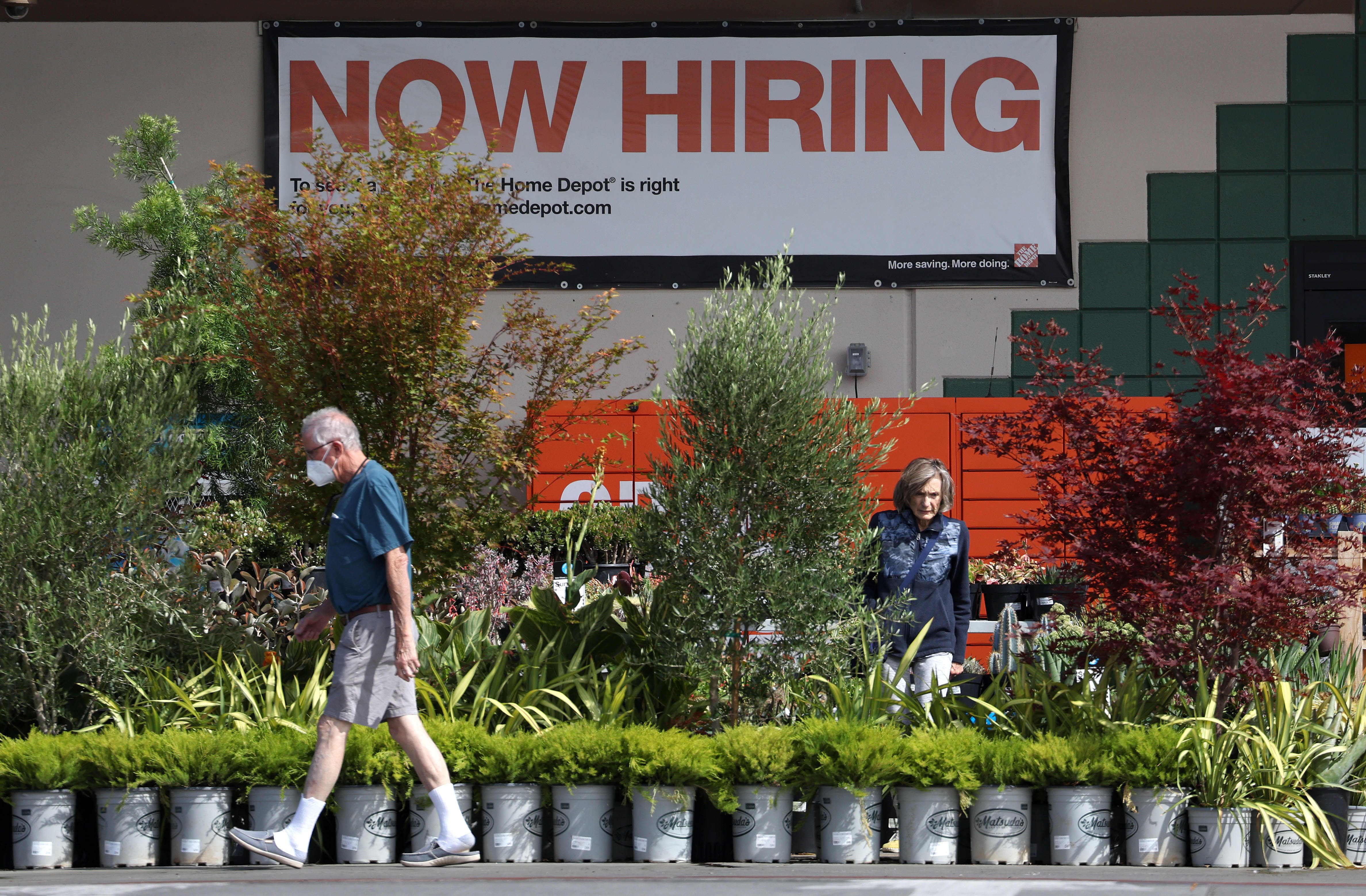
A “Now Hiring” sign is posted at a Home Depot store on August 05, 2022 in San Rafael, California.
Justin Sullivan | Getty Images

There were nearly 1 million more job openings than expected in July, an inflationary sign that the U.S. labor market is still extremely tight, the Bureau of Labor Statistics reported Tuesday.

Available positions totaled 11.24 million for the month, well in excess of the 10.3 million FactSet estimate, according to the Job Openings and Labor Turnover Survey. The total was about 200,000 higher than the 11.04 million in June, a number revised up from the initially reported 10.7 million.

Federal Reserve officials watch the JOLTS numbers closely for signs of slack in hiring.

The July numbers reinforced that there is still a considerable shortage of workers for available positions, with openings outnumbering available workers by just shy of a 2-to-1 margin. That, in turn, is inflationary as employers are forced to offer higher compensation to attract workers at a time when prices are rising near their fastest pace in more than 40 years.

Hiring declined during the month, falling to 6.38 million. Quits, a closely watched metric for worker confidence, also dropped, down to 4.18 million as those leaving their jobs as a percentage of the workforce declined one-tenth of a percentage point to 2.7%, still relatively high by historical standards.

Changing jobs has proven lucrative during the Covid era, with switchers seeing an average 6.7% annual wage growth rate, well ahead of the 4.9% rate of those who have stayed in their positions, according to the Atlanta Fed.

Total separations declined slightly in July to 5.93 million, as the rate edged lower to 3.9%. Layoffs and discharges were little changed at just under 1.4 million.

The JOLTS report comes three days ahead of the closely watched August nonfarm payrolls release Friday from the BLS. The Dow Jones estimate is for growth of 318,000, but the job openings numbers add potential upside to that count as companies continue to look to hire.

Fed Chairman Jerome Powell at last month’s meeting noted an “extremely tight labor market” in his remarks about the central bank’s efforts to bring down inflation.

Powell warned that ongoing hikes likely would result in “below-trend economic growth and some softening in labor market conditions.”

“But such outcomes are likely necessary to restore price stability and to set the stage for achieving maximum employment and stable prices over the longer run,” he added.

However, signs that hiring demand remains robust indicate that the rate increases may not be slowing growth as much as the Fed has hoped.

Traders upped their bets that the Fed will enact a third consecutive three-quarter point interest rate hike at its September meeting. The probability for that move over a half-point increase was 76.5% on Tuesday morning, according to CME Group data.

Get CyberSEO Lite (https://www.cyberseo.net/cyberseo-lite) – a freeware full-text RSS article import plugin for WordPress.

Read More

[The stream is slated to start at 10 a.m. ET. Please refresh the page if you do not see a player above at that time.]

Federal Reserve Chair Jerome Powell delivers a speech at the central bank’s annual economic symposium in Jackson Hole, Wyoming, on Friday at 10.a.m. ET.

Market participants have eagerly awaited Powell’s comments, searching for guidance on the extent to which policymakers will push against inflation and the criteria the central bank will refer to as it makes its decisions.

Powell’s comments come at a time when the Fed has taken drastic steps to tamp down rising prices. Though investors are looking for new guidance from the central bank leader, Powell is largely expected to issue the same inflation-fighting message, stressing that the Fed will use its rate-hiking power to rein in prices.

Powell’s speech follows the release of one of the Fed’s favorite inflation metrics earlier Friday: the personal consumption expenditures price index. July’s PCE reading showed a year-over-year gain of 6.3% in July, down from 6.8% in June. The index slipped 0.1% month over of month.

The core PCE index, which excludes food and energy prices, climbed 4.6% on an annualized basis, and rose 0.1% month over month.

Get CyberSEO Lite (https://www.cyberseo.net/cyberseo-lite) – a freeware full-text RSS article import plugin for WordPress.

Read More

The U.S. needs to return to the kind of economic and productivity growth it saw in mid-20th century to boost public spirits, according to a Nobel Prize-winning economist. 

“We badly need to get back to economic growth,” Edmund S. Phelps, director of the Center on Capitalism and Society at Columbia University, told CNBC’s “Squawk Box Europe” on Wednesday. 

“By that I don’t mean an artificial temporary boom or a slower descent into lower employment, I mean that we’ve really got to get productivity growth on an upward climb approaching what it was in the 50s and 60s,” he said. 

Phelps was awarded the 2006 Nobel in Economic Sciences for his work challenging the Phillips Curve, the view, popular in the 1950s and 60s, that the price for reduced unemployment was a one-time increase in inflation. 

Phelps introduced the factor of inflation expectations into the Phillips Curve, showing unemployment is determined by the functioning of the labor market rather than inflation figures, so a stabilization policy can only diminish short-term fluctuations in unemployment.  

“A lot of people listening to this program might think, well gee whiz, after centuries of rapid growth, haven’t we had enough? We’re not starving anymore after all, what’s all this fuss about economic growth?” Phelps told “Squawk Box Europe.”

“But I think it’s really important for people’s morale that they come home from time to time with better pay checks than they had before. It boosts their morale, it makes them less worried about how they’re doing compared with other people,” he continued. 

“When everybody is doing so-so, when you’re in virtual stagnation in terms of productivity, in that landscape, which we’re unfortunately in now, it’s really important that we get the growth rate up.” 

U.S. GDP fell 0.9% in the second quarter following a 1.6% drop in the first quarter, though analysts say the economy is not yet in a recession and may avoid one. 

Productivity, measured as nonfarm business employee output per house, also fell in both quarters, decreasing by 7.4% and 4.6% quarter-on-quarter. 

These were the weakest back-to-back readings since records began in 1947.

The U.S. recorded productivity growth of 2.8% from 1947-1973, which fell to 1.2% from 1973-1979, according to data from the U.S. Bureau of Labor Statistics. 

Productivity growth has failed to return to its post-war level since, coming in at 1.4% from 2007-2019 and 2.2% from 2019-2021.

On current economic pressures, Phelps commented: “The government has been running huge fiscal deficits in recent years, and as a result the public debt has risen to sky-high levels. To me, it’s just unimaginable that fiscal policy would be used at this point to create further stimulus to demand.

“I think we need to have somewhat lower demand to cool off the economy a bit and get the unemployment rate back to some sustainable level.” 

Natural market forces will slow the rate of inflation over several years, he said, but the Federal Reserve must be more aggressive than it has been and signal a willingness to continue to act in strong magnitudes.

Get CyberSEO Lite (https://www.cyberseo.net/cyberseo-lite) – a freeware full-text RSS article import plugin for WordPress.

Read More

Retail activity was flat in July as falling fuel prices held back gas station sales and consumers turned more heavily to online shopping, the Census Bureau reported Wednesday.

While advance retail sales were unchanged, total receipts excluding autos rose 0.4%. Economists surveyed by Dow Jones had been looking for a 0.1% increase in the top-line number and a flat total ex-autos. June’s gain was revised down to 0.8% from 1%.

Retail and food sales excluding gasoline and autos rose 0.7% from a month ago.

The numbers are adjusted seasonally but not for inflation, and come during a month when the consumer price index also was flat.

A tumble in fuel prices off their record nominal highs pushed down sales at the pump, with gas station receipts off 1.8%. Motor vehicle and parts dealers sales also fell sharply, declining 1.6%.

Gas prices had eclipsed $5 a gallon in many locations earlier in the summer, but fell through July and most recently were at $3.94 a gallon for regular unleaded, according to AAA.

“People appear to have used some of the savings from lower gas prices to spend more on other items, both in nominal and — very likely — real terms,” wrote Ian Shepherdson, chief economist at Pantheon Macroeconomics. “Auto sales have been severely constrained by the chip shortage, so pent-up demand likely is substantial. July’s other losers were department stores and clothing retailers, but all these components are noisy and subject to revisions.”

Those pullbacks in gas and auto sales were offset by a 2.7% increase in online sales and a 1.5% gain in miscellaneous stores.

Consumers have been fighting to keep up with an inflationary environment that has seen prices overall increase 8.5% from a year ago, close to the highest level in 40 years. Price rises have been especially pernicious in the food and energy category; even with the July slide in energy prices, gas station receipts climbed 39.9% from a year ago.

July provided some respite from inflation pressures, and the decline in fuel costs particularly allowed consumers to spend elsewhere.

Food sales rose just 0.2%, however, even as the food price index as measured by the Bureau of Labor Statistics increased 1.1% for the month. Sales at bars and restaurants also struggled, rising just 0.1%.

Some retailers also have struggled in the current environment.

Target on Wednesday said its earnings tumbled close to 90% from a year ago as it has had to mark down prices on unwanted inventory.

The Federal Reserve has been using interest rate increases to hold back inflation. The central bank enacted consecutive 0.75 percentage point hikes in June and July and is expected to keep moving rates higher until inflation comes down to the Fed’s 2% goal.

Correction: Target on Wednesday said its earnings tumbled close to 90% from a year ago. An earlier version misstated the metric.

Get CyberSEO Lite (https://www.cyberseo.net/cyberseo-lite) – a freeware full-text RSS article import plugin for WordPress.

Read More