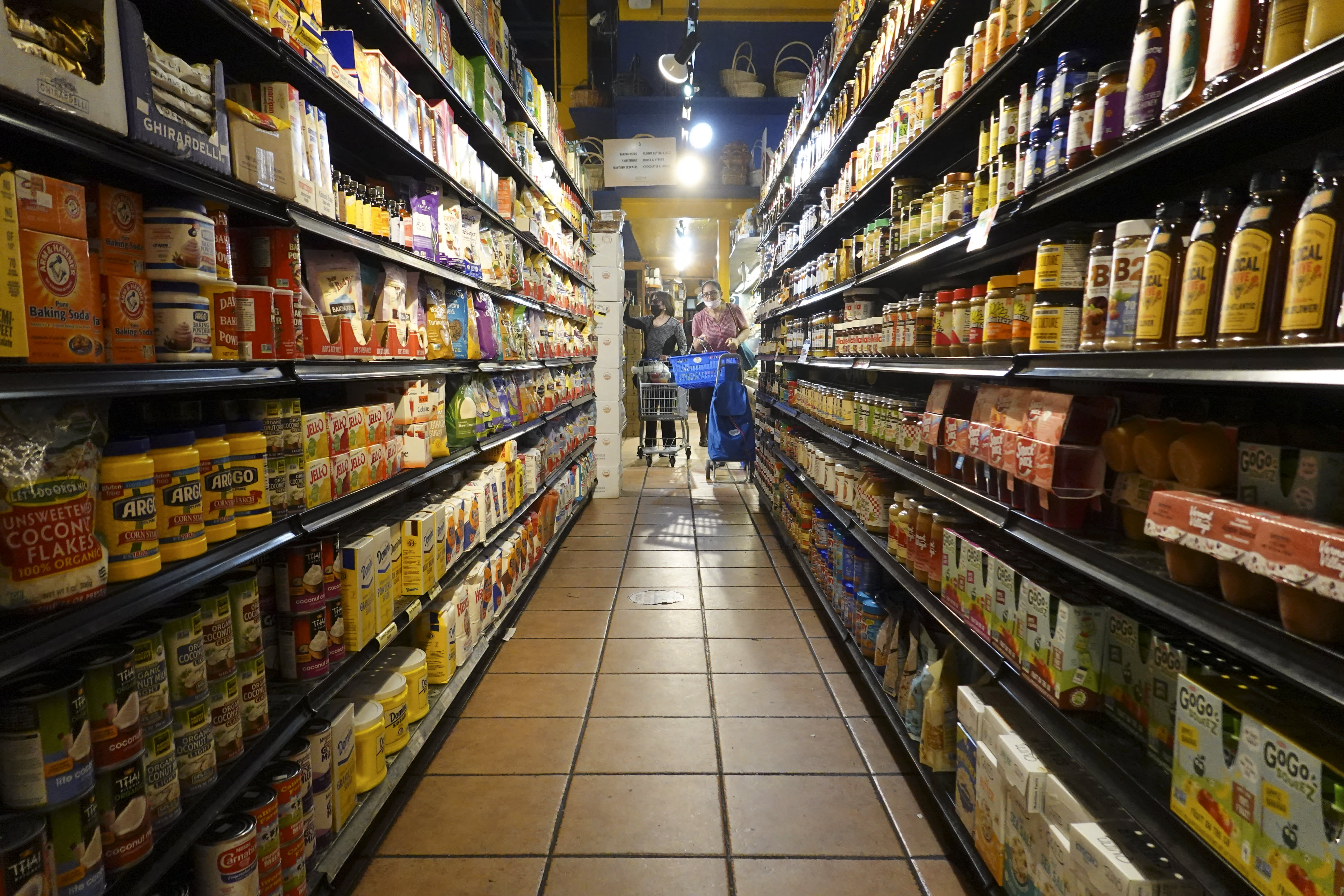
A customer shops for eggs in a Kroger grocery store on August 15, 2022 in Houston, Texas.
Brandon Bell | Getty Images

July’s consumer price index report finally showed a sign of potential relief – inflation ticked up less than expected from a year ago, and was flat on the month, meaning that a basket of items and services generally stayed the same price.

But some items have fallen, on a monthly and weekly basis, potentially signaling that inflation has passed its peak and may be cooling off.

This is welcome news to consumers who have been squeezed by higher prices and are looking for any sign of relief. Some of the top items whose prices have come down include eggs, milk and gasoline.

“Fuel inflation was really big and that’s going to have a pretty meaningful impact on consumers and their spending patterns,” said John Leer, chief economist at Morning Consult. “I think that’s actually a good thing for the economy.”

Grocery aisle prices down

Many of the items that have declined are tied to food and energy, often the most volatile costs that consumers deal with.

Grocery store staples have dipped. Large white eggs cost, on average, $2.14 for a dozen, during the week of Aug. 15-21, according to the USDA. That’s a whopping 60 cent drop from the prior week, when the average was $2.74 per dozen.

The average price for a gallon of milk slipped to $3.16 from $3.24 during the period of Aug. 8-12 from the previous month, and the average price of butter fell to $3.67 from $4.68 in the same timeframe, per USDA data.

Chicken breast prices also slipped on a weekly basis during the period of Aug. 8-12, but other parts of the chicken are declining as well – chicken wing prices have been trending down and are now cost less than they did pre-pandemic, according to data from the Department of Agriculture.

Oil pulled down fuel prices

Outside of food, declines can be seen in consumer goods and services related to energy.

This is because oil prices are often subject to big price swings as the balance between supply and demand shifts. This year, the war between Russia and Ukraine threw that balance off and the price of oil spiked when countries stopped buying from Russia, a major exporter.

However, oil prices have come back down, lowering the cost of energy and particularly gasoline. The national average for a gallon of regular gasoline is $3.918 as of Friday, according to AAA. While that’s higher than it was a year ago, it’s a solid decline from the $4.495 consumers were paying for gas a month ago, and a sharp drop from the recent high of $5.016 hit in June.

I think consumers increasingly believe that inflation is going to come down.
John Leer
chief economist at Morning Consult

That also potentially affected another area of the economy that saw a price dip month over month – airfares. The average price of a domestic airline ticket has dropped to $295 in August from $332 in July, according to travel site Hopper. That’s also back in-line with the average price for a domestic ticket in the same month in 2019.

Outside of fuel costs, this dip in ticket prices could be because consumer demand is fading, according to according to Kevin Gordon, a senior investment research manager at Schwab.

“That could be demand destruction,” he said, adding that the reopening from pandemic lockdowns inflated the price of things as consumers rushed to take vacations again. Now, as vacation season is winding down, that demand has fallen off.

One month doesn’t make a trend

Of course, one month of prices falling in some categories isn’t a trend.

The slowdown in price increases – and dips of costs of some items and services – may mark the beginning of declines, but more months of data would be needed to know for sure.

“I think it’s way too early to start taking a victory lap,” said Leer, adding that consumers should expect to be living in a world with elevated inflation for the next year and a half to two years.

In addition, it’s important to remember that falling prices, or inflation cooling off, may ultimately signal that the U.S. economy is slowing down.  

“You want the price pressures relieved, but what the end goal with that is probably that we’re getting closer to a recession,” said Gordon. As the Federal Reserve continues to increase its benchmark interest rate, it wants the economy to slow down but will try not to tip the U.S. into a recession which would lead to job losses.

Further, prices of other common items have remained stubbornly high and are still climbing. The price of most fruit, for instance, continues to stay high and even increase week after week, according to USDA data. Swift changes are normal as well — even though dairy fell through Aug. 12, prices of milk and butter ticked back up through Aug. 19, USDA found.

Coffee prices were up 3.5% from June to July, according to the Bureau of Labor Statistics. Housing costs such as rent have also remained high and are some of the hardest to pull back down, Gordon noted.

Still, seeing the prices of common items trend back down is a good thing for consumers and sentiment.

“I think consumers increasingly believe that inflation is going to come down,” said Leer.

Get CyberSEO Lite (https://www.cyberseo.net/cyberseo-lite) – a freeware full-text RSS article import plugin for WordPress.
Read More

A high street decorated with British Union Jack bunting in Penistone, UK. The End Fuel Poverty Coalition has warned “a tsunami of fuel poverty will hit the country this winter.”
Bloomberg | Bloomberg | Getty Images

LONDON — Facing soaring energy bills, rising costs and rapidly declining consumer purchasing power, small businesses across the U.K. are struggling to make ends meet.

New data on Wednesday showed U.K. inflation jumped to a 40-year high of 10.1% in July as food and energy costs continued to soar, exacerbating the country’s cost-of-living crisis.

The Bank of England expects consumer price inflation to top out at 13.3% in October, with the country’s average energy bills (set via a price cap) expected to rise sharply in the fourth quarter to eventually exceed an annual £4,266 ($5,170) in early 2023.

On Wednesday, a director of U.K. energy regulator Ofgem quit over its decision to add hundreds of pounds to household bills, accusing the watchdog of failing to strike the “right balance between the interests of consumers and the interests of suppliers.”

Real wages in the U.K. fell by an annual 3% in the second quarter of 2022, the sharpest decline on record, as wage increases failed to keep pace with the surging cost of living.

A new survey published Friday also showed consumer confidence falling to its lowest level since records began in 1974.

‘Absolute madness’

“While the energy price caps do not apply to businesses directly, millions of small business owners are still experiencing increased energy bills at a time when costs are rising in most operational areas,” said Alan Thomas, U.K. CEO at insurance firm Simply Business.

“Simultaneously, consumer purchasing power is going down as Brits cut back on non-essential spending, harming the books of SME [small and medium-sized enterprise] owners.”

This assessment was echoed by Christopher Gammon, e-commerce manager at Lincs Aquatics — a Lincolnshire-based store and warehouse providing aquariums, ponds and marine livestock.

The business has seen its energy costs rise by 90% so far since the war in Ukraine began, Gammon told CNBC on Thursday, and its owners are provisioning for further increases in the coming months.

“We are combating the rising cost with switching everything to LED, solar panels, wind turbines (planning in process) and closing down unused systems,” Gammon said.

“We have also had to increase the price of products — most of these have been livestock as they are now costing more to look after.”

Customers are increasingly withdrawing from keeping fish and reptiles due to the cost of maintenance, and on Wednesday the store had a customer bring in a snake they could no longer afford to care for.

The spiraling costs forced Lincs Aquatics to close a store in East Yorkshire, laying off several workers, while trying to offer pay rises to staff at its two remaining locations in Lincolnshire in order to help them through the crisis.

The business is also working to expand its online shop due to rising in-store upkeep costs, as heating water for marine aquariums and purchasing pump equipment become ever more expensive.

In early July, a quarterly survey from the British Chambers of Commerce found that 82% of businesses in the U.K. saw inflation as a growing concern for their business, with growth in sales, investment intentions and longer-term turnover confidence all slowing.

“Businesses face an unprecedented convergence of cost pressures, with the main drivers coming from raw materials, fuel, utilities, taxes, and labor,” said BCC Head of Research David Bharier.

“The continuing supply chain crisis, exacerbated by conflict in Ukraine and lockdowns in China, has further compounded this.”

BCC Director General Shevaun Haviland added that “the red lights on our economic dashboard are starting to flash,” with almost every indicator deteriorating since the March survey.

Phil Speed, an independent distributor for multiservice company Utility Warehouse, based in Skegness, England, liaises with brokers to find energy deals for business clients.

He told CNBC earlier this week that for the first time in 10 years, he had been unable to obtain a better deal for a client than their out-of-contract rate — the typically expensive rates paid when a business or individual does not have a contracted deal in place.

“I think the unit rate she was quoting was 60p [pence] a unit for gas, which is just ridiculous. I’d imagine a year ago, we’d have been looking at 5 or 6p. It’s just absolute madness,” Speed said.

“We’ve got no idea what’s going to be presented to us, because we’ve got no idea what’s going to happen. The price is just going ballistic. No-one’s going to buy it.”

The cost of gas for both businesses and consumers are only expected to increase through the colder winter months. Speed noted that local cafes cooking on gas will likely struggle, as they have no choice but to continue using it, unless they can replace gas appliances with electric ones.

‘Scream very loudly at somebody’

Rail strikes have already brought the country to a halt on multiple days throughout the summer and look set to continue, while postal workers, telecoms engineers and dock workers have all voted to strike as inflation erodes real wages.

Conservative leadership favorite Liz Truss was earlier this month forced into a dramatic U-turn on a plan to cut public sector pay outside London, which would have axed wages for teachers, nurses, police and the armed forces alike.

Local authorities recently offered state school support staff a flat pay rise of £1,925 per year, meaning a 10.5% increase for the lowest-paid staff and just over 4% for the highest earners, after pressure from three of the country’s largest unions.

One woman in her early fifties – a member of support staff at a state school in Lincolnshire who asked not to be named due to the sensitive situation and concerns on public reprisals – told CNBC that years of real-terms pay cuts had left many low-paid public sector workers struggling to make ends meet.

The British government in 2010, in the aftermath of the global financial crisis, announced a two-year pay freeze for public sector workers, followed by a 1% average cap on public sector pay awards which was lifted in 2017, with average pay rises increasing to roughly 2% by 2020.

While the 10.5% rise for the lowest-paid school support staff will ease the pressure, the woman said her energy costs had doubled and her private landlord had attempted to increase her rent by £40 per month, which she had not agreed to and which may mean she would need to sell her car to cover basic living expenses.

She called on the government to temporarily reduce the “standing charge,” a fixed daily amount households have to pay on most gas and electricity bills no matter how much they actually use, and to up its efforts to recoup one-off “windfall taxes” from energy companies such as BP, Shell and Centrica, which are reporting record profits..

“I think this is an even bigger crisis than [the Covid-19 pandemic], because this is going to affect not just lower earners, but maybe even middle earners as well, because I don’t see how anybody can absorb those kinds of energy costs,” she said.

The pressure being exerted on businesses and the government to increase wages in the face of skyrocketing living costs has raised further concerns about inflation becoming entrenched – but this consideration is far removed from the reality of working families increasingly being forced to cut back on essentials.

“It’s alright saying ‘we can’t keep putting people’s pay up, that will make the cost of living worse,’ but the cost of living is out of control already, and the only way for people to survive is if their wages increase,” the woman said.

“I know it’s a catch 22, but I don’t see a way around that really — you’ve got to eat.”

The situation in recent months, even before the anticipated worsening of the energy crisis, has already begun to take a toll.

“I just think I’m a very honest, hardworking person. I’ve never committed a crime, always done things right, but now I’m starting to feel like that gets you nowhere in this country,” she said.

“For the first time in my life, I want to go out and march in protest and scream very loudly at somebody, and you just think ‘what does it take?'”

Get CyberSEO Lite (https://www.cyberseo.net/cyberseo-lite) – a freeware full-text RSS article import plugin for WordPress.
Read More

Initial filings for unemployment benefits declined slightly last week though they were consistent with a drift higher in layoffs that began in the spring, the Labor Department reported Thursday.

Jobless claims totaled 250,000 for the week ended Aug. 13, down 2,000 from the previous week and below the 260,000 Dow Jones estimate.

The four-week moving average for claims, which helps smooth out weekly volatility, also fell by 2,750 to 246,750.

Earlier this year, claims had hit their lowest level in more than 50 years, but began moving higher in April after bottoming at 166,000. The four-week moving average has risen during that time by nearly 80,000.

Continuing claims, which run a week behind the headline number, totaled 1.437 million, an increase of 7,000.

Policymakers are watching the jobs market closely at a time when inflation is running near 40-year highs. Federal Reserve officials have instituted a series of interest rate increases aimed in part at cooling a labor market in which there are nearly two jobs open for every available worker.

At their July meeting, Fed officials noted “tentative signs of a softening outlook for the labor market” that included a rise in weekly claims, according to minutes released Wednesday. Policymakers said they were determined to continue to raise interest rates until inflation under control even if meant more a slowdown in hiring.

“Unfortunately, what’s good for the American worker is bad for the Fed’s attempt to being inflation back down to 2% and this will complicate their job and cause them to raise rates higher and for longer than many people currently expect,” said Chris Zaccarelli, chief investment officer for Independent Investor Alliance.

In other economic news Thursday, the Philadelphia Fed reported that its monthly manufacturing survey for August rose to a reading of 6.2, representing the percentage difference between companies expecting expansion vs. contraction. That was an improvement over July’s minus-12.3.

The level was above the estimate for a minus-5 and helped quell fears that manufacturing might be headed for a major slowdown. A similar survey on Monday from the New York Fed fell a stunning 40 points as respondents indicated that business conditions were deteriorating.

The indexes for prices paid and received both declined on the month, though they remain well into territory that indicates inflation is still present. Hiring also improved as did new orders, though the latter still registered a reading of minus-5.1.

Get CyberSEO Lite (https://www.cyberseo.net/cyberseo-lite) – a freeware full-text RSS article import plugin for WordPress.
Read More

Construction workers outside the Marriner S. Eccles Federal Reserve Building, photographed on Wednesday, July 27, 2022 in Washington, DC.
Kent Nishimura | Los Angeles Times | Getty Images

The Federal Reserve’s path to bringing down runaway inflation while keeping the economy from slipping into a major downturn is still open but is getting narrower, according to Goldman Sachs.

As the central bank looks to keep raising interest rates, the economy is teeming with mixed signals: rapidly rising payroll figures against sharply declining housing numbers, falling gasoline prices vs. surging shelter and food costs, and low consumer sentiment against steady spending numbers.

Amid it all, the Fed is trying to strike a balance between slowing things down, but not by too much.

On that score, Goldman economists think there have been clear wins, some losses and a landscape ahead that poses substantial challenges.

“Our broad conclusion is that there is a feasible but difficult path to a soft landing, though several factors beyond the Fed’s control can ease or complicate that path and raise or lower the odds of success,” Goldman economist David Mericle said in a client note Sunday.

Slow growth, high inflation

One of the biggest inflation drivers has been outsized growth that has created imbalances between supply and demand. The Fed is using interest rate increases to try to damp down demand so supply can catch up, and supply chain pressures, as measured by a New York Fed index, are at their lowest since January 2021.

So on that score, Mericle said the Fed’s efforts have “gone well.” He said the rate increases — totaling 2.25 percentage points since March — have “achieved a much-need deceleration” regarding growth and specifically demand.

In fact, Goldman expects GDP to grow at just a 1% pace over the next four quarters, and that’s coming off consecutive declines of 1.6% and 0.9%. Though most economists expect that the National Bureau of Economic Research will not declare the U.S. in recession for the first half of the year, the slow-growth path makes the Fed’s balancing act more difficult.

On a similar count, Mericle said the Fed’s moves have helped narrow the supply-demand gap in the labor market, where there are still nearly two job openings for every available worker. That effort “has a long way to go,” he wrote.

However, the biggest problem remains stubbornly high inflation.

The consumer price index was flat in July but still rose 8.5% from a year ago. Wages are surging at a strong clip, with average hourly earnings up 5.2% from a year ago. Consequently, the Fed’s efforts to halt a spiral in which higher prices feed higher wages and perpetuate inflation have “shown little convincing progress so far,” Mericle said.

“The bad news is that high inflation is broad-based, measures of the underlying trend are elevated, and business inflation expectations and pricing intentions remain high,” he added.

Doubts about the Fed’s policy path

Fighting inflation might require higher rate hikes than the market currently anticipates.

Goldman’s projection is that the Fed raises benchmark rates by another percentage point before the end of the year, but Mericle acknowledged that there is “upside risk” due to “the recent easing in financial conditions, the robust pace of hiring, and signs of stickiness in wage growth and inflation.”

Indeed, former New York Fed President William Dudley said Monday he thinks the market is underestimating the future path of rate hikes and, consequently, the risks of a hard landing or recession.

“The market is misunderstanding what the Fed is up to,” he told CNBC’s “Squawk Box” in a live interview. “I think the Fed is going to be higher for longer than what market participants understand at this point.”

In Dudley’s view, the Fed will keep hiking until it is sure inflation is heading back to the central bank’s 2% target. Even by the most generous inflation measure, the core personal consumption expenditures price index that the Fed follows, inflation is still running at 4.8%.

“The labor market is much tighter than the Fed wants. The wage inflation rate is too high, not consistent with 2% inflation,” he added.

Dudley expects the rates to keep going up until the employment dynamic has shifted enough to get the unemployment rate “well above 4%,” compared to its current level of 3.5%.

“Whenever the unemployment rate has risen by a half percentage point or more, the result has been full-blown recession,” he said.

One measure of the relationship between unemployment and a recession is called the Sahm Rule, which states that recessions do follow when the three-month average of unemployment rises half a percentage point above its lowest over the previous 12 months.

So that would only require a rate of 4% under the Sahm Rule. In their most recent economic projections, members of the rate-setting Federal Open Market Committee don’t see the jobless level breaking that rate until 2024.

Get CyberSEO Lite (https://www.cyberseo.net/cyberseo-lite) – a freeware full-text RSS article import plugin for WordPress.
Read More

Gas station prices are seen in Bethesda, Maryland on August 11, 2022.
Mandel Ngan | AFP | Getty Images

There was more good news Friday for inflation, as import prices fell more than expected and brought some much-needed relief for consumers.

The report capped off a relatively upbeat week for those worried about rising prices — and “relatively” is the operative word — as the U.S. is on pace this year to import just over $4 trillion of goods and services this year, according to the latest Bureau of Economic Analysis data.

With Americans already paying huge bills for food, energy and a host of other items in their daily lives, any respite is a welcome one. After all, the monthly import price drop of 1.4% was just the first this year, and the year-over-year increase is still more than 8.8%.

That news followed reports earlier in the week that both wholesale and retail price increases abated for the month. Producer prices declined 0.5%, and consumer prices including food and fuel were flat, both numbers owing largely to a sharp slide in most of the energy complex.

People are noticing: A New York Federal Reserve survey released Monday showed consumers are expecting inflation to stay high but not by as much as previous months. On Friday, the University of Michigan consumer sentiment survey — whose ups and downs tend to ride in tandem with prices at the pump — was higher than expected, though still just off record-low levels hit in June.

‘This is just one report’

Taken together, the numbers are reason for at least a little optimism. But it’s probably wise to put exuberance on hold.

The consumer price index is still up 8.5% from a year ago, while the producer price index has surged 9.8% during the same period.

Krishna Guha, who heads global policy and central bank strategy for Evercore ISI, cautioned in a client note on CPI that, “while the report is consistent with the notion that inflation pressures may finally have peaked, this is just one report.”

Similar comments came Friday from Richmond Federal Reserve President Thomas Barkin. The central bank official told CNBC that the inflation news was “very welcome,” but added that he didn’t see any reason to pull back on the interest rate increases that some economists fear will drag the U.S. into a recession.

“There is a very long way to go before the Fed will feel it has sufficient compelling evidence that inflation is moderating to stop raising rates,” Guha added.

The Fed and investors will get a look next week at how much of an impact inflation has made on spending.

View from the consumer

The Wednesday advance report from the Commerce Department is expected to show a modest 0.2% headline gain for July in retail sales after a 1% increase in June, according to FactSet. The report is not adjusted for inflation.

However, there is a wide range of opinion on where the numbers could land.

Citigroup said its credit card data show a potential 1.1% decline for the month, while Bank of America said it sees a 0.2% decrease, though control group spending — excluding a variety of volatile categories — may have risen 0.9%.

Fed officials will be watching closely to see larger trends in how inflation is impacting Main Street.

“It does appear that a tentative peak in inflation is in place,” said Joseph Brusuelas, chief economist at RSM.

However, he said this week’s numbers are likely to do little to sway a Fed intent on stomping inflation down to the central bank’s 2% target.

“I think that the July inflation does nothing to alter the path of Fed policy, and any notion that a Fed pivot is at hand should be dismissed,” he said. “We are some months away from any potential clear and convincing evidence that inflation is well on its way back to the 2% target that currently defines price stability.”

Get CyberSEO Lite (https://www.cyberseo.net/cyberseo-lite) – a freeware full-text RSS article import plugin for WordPress.
Read More

Wholesale prices fell in July for the first time in two years as a plunge in energy prices slowed the pace of inflation, the Bureau of Labor Statistics reported Thursday.

The producer price index, which gauges the prices received for final demand products, fell 0.5% from June, the first month-over-month decrease since April 2020, the month after Covid-19 was declared a pandemic. Economists surveyed by Dow Jones had been expecting an increase of 0.2%.

On an annual basis, the index rose 9.8%, the lowest rate since October 2021. That compares with an 11.3% increase in June and the record 11.7% gain in March.

Most of the decline came from energy, which dropped 9% at the wholesale level and accounted for 80% of the total decline in goods prices, which fell 1.8%. The index for services rose 0.1%.

Stripping out food, energy and trade services, PPI increased 0.2% in July, which was less than the expected 0.4% gain. Core PPI rose 5.8% from a year ago.

The numbers come a day after the consumer price index showed that inflation was flat in July though up 8.5% from a year ago. The easing in the CPI also reflected the slide in energy prices that has seen prices at the pump fall below $4 a gallon after hitting record nominal levels above $5 earlier in the summer.

“Cooling prices paid by producers portend a further cooling for consumer prices, as producer prices are further up the inflation pipelines,” said Jeffrey Roach, chief economist at LPL Financial. “We expect producer prices to ease as supply chains improve. It could take up to three months for improved supply chains to affect prices for the end consumer.”

Federal Reserve officials are watching the inflation data closely for clues about where the economy stands after more than a year of wrestling with high inflation.

Before July’s easing, prices had been running at their highest levels in more than 40 years. Supply chain issues, demand imbalances, and high amounts of fiscal and monetary stimulus associated with the pandemic had driven the annual CPI rate past 9%, well above the Fed’s 2% long-run target.

This week’s data could give the Fed reason to dial back rate increases that have come in successive 0.75 percentage point increments in June and July. Markets are now pricing in a 0.5 percentage point move in September.

A separate Labor Department report Thursday showed that weekly jobless claims totaled 262,000 for the week ended Aug. 6, an increase of 14,000 from the previous week though 2,000 below the estimate.

Claims have been elevated in recent weeks in a sign that a historically tight labor market is shifting. Continuing claims rose 8,000 to 1.43 million.

Get CyberSEO Lite (https://www.cyberseo.net/cyberseo-lite) – a freeware full-text RSS article import plugin for WordPress.
Read More

Prices that consumers pay for a variety of goods and services rose 8.5% in July from a year ago, a slowing pace from the previous month due largely to a drop in gasoline prices.

On a monthly basis, the consumer price index was flat as energy prices broadly declined 4.6% and gasoline fell 7.7%, according to the Bureau of Labor Statistics. That offset a 1.1% monthly gain in food prices and a 0.5% increase in shelter costs.

Economists surveyed by Dow Jones were expecting headline CPI to increase 8.7% on an annual basis and 0.2% monthly.

Excluding volatile food and energy prices, so-called core CPI rose 5.9% annually and 0.3% monthly, compared with respective estimates of 6.1% and 0.5%.

Even with the lower-than-expected numbers, inflation pressures remained strong.

The jump in the food index put the 12-month increase to 10.9%, the fastest pace since May 1979. Butter is up 26.4% over the past year, eggs have surged 38% and coffee is up more than 20%.

Despite the monthly drop in the energy index, electricity prices rose 1.6% and were up 15.2% from a year ago. The energy index rose 32.9% from a year ago.

Used vehicle prices posted a 0.4% monthly decline, while apparel prices also fell, easing 0.1%, and transportation services were off 0.5% as airline fares fell 1.8% for the month and 7.8% from a year ago.

Markets reacted positively to the report, with futures tied to the Dow Jones Industrial Average up more than 400 points and government bond yields down sharply.

“Things are moving in the right direction,” said Aneta Markowska, chief economist at Jefferies. “This is the most encouraging report we’ve had in quite some time.”

The report was good news for workers, who saw a 0.5% monthly increase in real wages. Inflation-adjusted average hourly earnings were still down 3% from a year ago.

Shelter costs, which make up about one-third of the CPI weighting, continued to rise and are up 5.7% over the past 12 months.

People shop at a grocery store on June 10, 2022 in New York City.
Spencer Platt | Getty Images

The numbers indicate that inflation pressures are easing somewhat but still remain near their highest levels since the early 1980s.

Clogged supply chains, outsized demand for goods over services, and trillions of dollars in pandemic-related fiscal and monetary stimulus have combined to create an environment of high prices and slow economic growth that has bedeviled policymakers.

The July drop in gas prices has provided some hope after prices at the pump rose past $5 a gallon. But gasoline was still up 44% from a year ago and fuel oil increased 75.6% on an annual basis, despite an 11% decline in July.

Federal Reserve officials are using a recipe of interest rate increases and related monetary policy tightening in hopes of beating back inflation numbers running well ahead of their 2% long-run target. The central bank has hiked benchmark borrowing rates by 2.25 percentage points so far in 2022, and officials have provided strong indications that more increases are coming.

There was some good news earlier this week when a New York Fed survey indicated that consumers have pared back inflation expectations for the future. But for now, the soaring cost of living remains a problem.

While inflation has been accelerating, gross domestic product declined for the first two quarters of 2022. The combination of slow growth and rising prices is associated with stagflation, while the two straight quarters of negative GDP meets a widely held definition of recession.

Wednesday’s inflation numbers could take some heat off the Fed.

Recent commentary from policymakers has pointed toward a third consecutive 0.75 percentage point interest rate hike at the September meeting. Following the CPI report, market pricing reversed, with traders now anticipating a better chance of a lesser 0.5 percentage point move.

“At the very least, this report takes the pressure off the Fed at the next meeting,” Markowska said. “They’ve been saying they’re ready to deliver a 75 basis point hike if they have to. I don’t think they have to anymore.”

Get CyberSEO Lite (https://www.cyberseo.net/cyberseo-lite) – a freeware full-text RSS article import plugin for WordPress.
Read More

A shopping cart is seen in a supermarket as inflation affected consumer prices in Manhattan, New York City, U.S., June 10, 2022.
Andrew Kelly | Reuters

If inflation has been the biggest threat to U.S. economic growth, then July’s data should provide signs that there’s at least some relief in the pipeline.

Prices were flat for the month as gauged by the items that the Bureau of Labor Statistics tracks for its consumer price index. That marked the first time the aggregate measure hadn’t posted a month-over-month increase since May 2020, when the widely followed index showed a modest decline.

Just a month ago, CPI posted its fastest 12-month gain since November 1982, following a trend that helped send economic growth into contraction for the first half of the year, stirring up talk of a recession.

But with at least the short-term trend indicating the rate of price increases is abating, economic optimism is perking up.

No recession, for now

“The whole recession narrative really needs to be put on a shelf for now,” said Aneta Markowska, chief economist at Jefferies. “I think it’s going to be shifting to a stronger-for-longer narrative, which is really supported by a reversal in inflation.”

Markowska, whose forecasts this year have been accurate, sees solid growth in the near term, including a 3% growth rate in the third quarter. The Atlanta Federal Reserve’s GDPNow gauge, which tracks economic data in real time, pointed to a 2.5% growth rate in a Wednesday update, up 1.1 percentage points from its last one on Aug. 4.

However, Markowska also expects pressures to intensify in 2023, with a recession likely in the back part of the year.

Indeed, there was a little bit for both arguments in the CPI report.

Most of the tempering in inflation came because of a fall in energy prices. Gasoline slid 7.7%, the biggest monthly decline since April 2020. Fuel oil tumbled 11% as energy-related commodity prices were off 7.6%.

Transportation services cost increases also came off the boil, with airline fares tumbling 7.8% to reverse a trend that has seen tickets surge 27.7% over the past year.

But there were few other signs of inflation declines in the report, with food costs particularly high. The food index, in fact, rose 1.1% on the month, and its 10.9% pace over the past 12 months is the highest since May 1979.

That’s causing worries at places such as City Harvest, which helps feed needy New Yorkers who have been hit especially hard by price surge that began last year.

“We’re seeing many more children come into food pantries,” said Jilly Stephens, the organization’s CEO. “Food insecurity had been intractable even before the pandemic hit. Now we’re seeing even more people turn to food pantries because of the rising prices.”

Stephens said the number of children seeking food assistance about doubled a year after the Covid pandemic hit, and the organization is struggling to keep up.

“We’re always optimistic, because we are supported by incredibly generous New Yorkers,” she said.

People keep spending

Despite the surging prices, consumers have been resilient, continuing to spend even with inflation-adjusted wages contracting 3% over the past year.

Jonathan Silver, CEO of Affinity Solutions, which tracks consumer behavior through credit and debit card transactions, said spending is at a healthy pace, rising about 10.5% over the past year, though inflation is influencing behavior.

“When you start to look at specific categories, there’s been a lot of shifting in spending, and as a result, some categories are being impacted more than others by inflation,” he said. “People are delaying their spending on discretionary items.”

For instance, he said department store spending has fallen 2.4% over the past year, while discount store spending has risen 17%. Amusement park spending is down 18%, but move theaters are up 92%. Some of those numbers are influenced by rising prices, but they generally reflect the level of transactions as well.

As inflation eases, Silver expects discretionary spending to increase.

“We believe there will be a spike later in the year that will create an upward slope to the spending in key categories where the consumer has been delaying and deferring spending,” he said. “Consumers may get a holiday present of some relief on food prices.”

In the meantime, the year-over-year inflation pace is still running at 8.5%. That’s just off the most aggressive rise in 40 years and a “worryingly high rate,” said Rick Rieder, chief investment officer of global fixed income at asset management giant BlackRock.

At the center of worries about global growth is the Federal Reserve and concerns that its interest rate hikes aimed at controlling inflation will slow the economy so much that it will fall into recession.

Following Wednesday’s report, traders shifted their bets to expecting the Fed to hike just half a percentage point in September, rather than the previous trend toward 0.75 percentage points, a move that Rieder said could be mistaken.

“The persistence of still solid inflation data witnessed today, when combined with last week’s strong labor market data, and perhaps especially the still solid wage gains, places Fed policymakers firmly on the path toward continuation of aggressive tightening,” he wrote.

Get CyberSEO Lite (https://www.cyberseo.net/cyberseo-lite) – a freeware full-text RSS article import plugin for WordPress.
Read More

Farmers harvest a wheat field near Melitopol in Ukraine. Wheat, soybean, sugar, and corn futures have fallen from their March highs back to prices seen at the start of 2022.
Olga Maltseva | Afp | Getty Images

Food prices dropped significantly in July from the previous month, particularly the costs of wheat and vegetable oil, according to the latest figures from the United Nations’ Food and Agriculture Organization.

But the FAO said that while the drop in food prices “from very high levels” is “welcome,” there are doubts over whether the good news will last.

“Many uncertainties remain, including high fertilizer prices that can impact future production prospects and farmers’ livelihoods, a bleak global economic outlook, and currency movements, all of which pose serious strains for global food security,” FAO chief economist Maximo Torero said in a press release.

The FAO food price index, which tracks the monthly change in the global prices of a basket of food commodities, fell 8.6% in July from the month before. In June, the index fell just 2.3% month on month.

However, the index in July was still 13.1% higher than July 2021.

Prices in the short term may fall further, if futures are anything to go by. Wheat, soybean, sugar, and corn futures have fallen from their March highs back to prices seen at the start of 2022.

For example, the wheat contracts closed at $775.75 per bushel on Friday, down from a 12-year high of $1,294 in March, and around the $758 price set in January.

Why prices fell

Analysts cited a mix of both demand and supply reasons for the slide in food prices: Ukraine and Russia’s closely watched agreement to resume exports of grain through the Black Sea after months of blockade; better-than-expected crop harvests; a global economic slowdown; and the strong U.S. dollar.

Rob Vos, the director of markets, trade and institutions at the International Food Policy Research Institute, pointed to the news that the United States and Australia are set to deliver bumper wheat harvests this year, which will improve supply since shipment from Ukraine and Russia have been curtailed.

The higher U.S. dollar also lowers the price of staples, since commodities are priced in U.S. dollars, Vos said. Traders tend to ask for lower nominal dollar prices of commodities when the greenback is expensive.

The widely heralded U.N.-backed deal between Ukraine and Russia also helped to cool the market. Ukraine was the world’s sixth-biggest wheat exporter in 2021, accounting for 10% of global wheat market share, according to the United Nations.

The first shipment of Ukrainian grain — 26,000 tons of maize — since the invasion left the country’s southwestern port of Odesa last Monday.

Skepticism over Ukraine-Russia deal

Global skepticism over whether Russia will keep its end of the bargain hangs in the air.

Russia fired a missile onto Odesa just hours after the U.N.-brokered deal in late-July.

And freight and insurance companies may still think it’s too risky to ship grain out of a war zone, Vos said, adding that food prices remain volatile and any new shock can cause more price surges.

“To make a difference it will not be enough to get a few shipments out, but at least 30 or 40 per month to get the existing grains stored in Ukraine out, as well as the produce of the upcoming harvest,” said Vos.

“To help stabilize markets, the deal will need to hold in full also during the second half of the year since that is the period where Ukraine does most of its exports.”

Even with the existing agreement, arable Ukrainian land may continue to be destroyed “for as long as the war continues,” which will result in even less crop yield next year, Carlos Mera, the head of agri commodities market research at Rabobank, told CNBC’s “Street Signs Europe” last week.

“Once this [grain] corridor is over, we might see even more price increases going forward,” Mera said. Consumers could also see further price increases as there is normally a lag of three to nine months before a movement in commodity prices is reflected on supermarket shelves.

Then there is the pressure of exporting enough grain as quickly as possible from a war zone.

“It’s time that we’re working again. I don’t see us exporting two [to] five million tons per month out of these Black Sea ports,” John Rich, the executive chairman of Ukrainian poultry giant Myronivsky Hliboproduct (MHP), told CNBC’s “Capital Connection” on Monday.

“Hungry people, at the end of the day, get hungry very quickly after a week.”

In a note published earlier this month, credit rating agency Fitch Ratings’ analysts wrote that a possible increase in fertilizer prices, which fell recently — but which are still double that of 2020 — could cause grain prices to jump again.

Russia’s restriction of gas supply has led European natural gas prices to spike. Natural gas is a key ingredient in nitrogen-based fertilizers. La Nina weather patterns could disrupt grain harvests later this year as well, they added.

And the fall in food prices is not all good news. Part of the reason why staples have become cheaper is that traders and investors are pricing in recessionary fears, the analysts said.

The global manufacturing purchasing managers’ index has been in decline, while the U.S. Federal Reserve seems bent on raising interest rates to curb inflation even if it triggers a recession, the Fitch team wrote.

Food staples

Cereal prices, under which wheat falls, fell by 11.5% month on month, the FAO index showed. Prices of wheat specifically fell by 14.5%, partly because of the reaction to the Russia-Ukraine grain deal, and better harvests in the Northern Hemisphere, the FAO said.

Vegetable oil prices fell by 19.2% month on month — a 10-month low — in part because of ample palm oil exports from Indonesia, lower crude oil prices, and lack of demand for sunflower oil.

Sugar prices dipped by 3.8% to a five-month low in light of shrinking demand, a weaker Brazilian real against the greenback, and increased supply from Brazil and India.

Dairy and meat prices dropped by 2.5% and 0.5% respectively.

Get CyberSEO Lite (https://www.cyberseo.net/cyberseo-lite) – a freeware full-text RSS article import plugin for WordPress.
Read More

Shoppers inside a grocery store in San Francisco, California, U.S., on Monday, May 2, 2022. 
David Paul Morris | Bloomberg | Getty Images

The consumer outlook for inflation decreased significantly in July amid a sharp drop in gas prices and a growing belief that the rapid surges in food and housing also would ebb in the future.

The New York Federal Reserve’s monthly Survey of Consumer Expectations showed that respondents expect inflation to run at a 6.2% pace over the next year and a 3.2% rate for the next three years.

While those numbers are still very high by historical standards, they mark a big drop-off from the respective 6.8% and 3.6% results from the June survey.

Through June, food prices rose 10.4% over the past year, according to the Bureau of Labor Statistics. They are still expected to climb 6.7% over the next 12 months, but that’s a decline from the June survey of 2.5 percentage points, the biggest fall in a data series going back to June 2013.

Likewise, respondents see gas prices, which rose 60% over the past year, increasing at just a 1.5% pace over the next year, a slide of 4.2 percentage points from June, the second-biggest monthly decline in the survey’s history.

The price of regular gas has come down about 67 cents a gallon over the past month though it remains 87 cents higher than a year ago, according to AAA. Commodity prices overall have been falling significantly as well.

Finally, home prices are expected to rise 3.5% from June’s 4.4%, the lowest projected gain since November 2020.

Five-year inflation expectations also slipped, dropping 0.5 percentage point to 2.3%.

The results come as the Fed has been raising interest rates aggressively to bring down inflation running at its highest level in more than 40 years. The central bank in 2022 has hiked benchmark rates four times for a total of 2.25 percentage points, and market pricing indicates a third consecutive 0.75 percentage point increase in September, according to CME Group data.

However, the New York Fed results from July might give policymakers reason to pull back if not in September then later in the year if the inflation data cooperates. The Fed targets inflation at 2% over the long run, so the projected levels in the survey remain well above the central bank’s comfort level.

Over the weekend, Fed Governor Michelle Bowman said she doesn’t expect inflation to come down anytime soon and sees a need to keep pushing rates higher. San Francisco Fed President Mary Daly echoed those sentiments, saying the increases are “far from done.”

Those comments came after the BLS on Friday reported much higher numbers for payroll growth — 528,000 — and wages, with average hourly earnings jumping 5.2%.

The New York Fed survey also showed that overall household spending growth for the next year is expected to cool to 6.9%. That’s also a comparatively high number over the longer run but well below the record-high 9% result from May. The 1.5 percentage point monthly decline is the largest in the survey’s history.

Consumers also grew slightly more optimistic on stock prices during a month that saw the S&P 500 soar 9%, with 34.3% now expecting higher prices over the next 12 months.

Get CyberSEO Lite (https://www.cyberseo.net/cyberseo-lite) – a freeware full-text RSS article import plugin for WordPress.
Read More