Are you debating whether to make the transition to headless commerce? Headless commerce might be a relatively new concept to several people, but in the world of tech developers, it is one of the highly discussed topics.  Several businesses also do not understand the need to switch to the highly hyped headless commerce when they […]

The post How to Switch to Headless Commerce appeared first on Entrepreneurship Life.

Read More

The Federal Reserve on Wednesday launched its biggest broadside yet against inflation, raising benchmark interest rates three-quarters of a percentage point in a move that equates to the most aggressive hike since 1994.

Ending weeks of speculation, the rate-setting Federal Open Market Committee took the level of its benchmark funds rate to a range of 1.5%-1.75%, the highest since just before the Covid pandemic began in March 2020.

Stocks were volatile after the decision but turned higher as Fed Chairman Jerome Powell spoke in his post-meeting news conference.

“Clearly, today’s 75 basis point increase is an unusually large one, and I do not expect moves of this size to be common,” Powell said. He added, though, that he expects the July meeting to see an increase of 50 or 75 basis points. He said decisions will be made “meeting by meeting” and the Fed will “continue to communicate our intentions as clearly as we can.”

“We want to see progress. Inflation can’t go down until it flattens out,” Powell said. “If we don’t see progress … that could cause us to react. Soon enough, we will be seeing some progress.”

FOMC members indicated a much stronger path of rate increases ahead to arrest inflation moving at its fastest pace going back to December 1981, according to one commonly cited measure.

The Fed’s benchmark rate will end the year at 3.4%, according to the midpoint of the target range of individual members’ expectations. That reflects an upward revision of 1.5 percentage points from the March estimate. The committee then sees the rate rising to 3.8% in 2023, a full percentage point higher than what was expected in March.

2022 growth outlook cut

Officials also significantly cut their outlook for 2022 economic growth, now anticipating just a 1.7% gain in GDP, down from 2.8% from March.

The inflation projection as gauged by personal consumption expenditures also rose to 5.2% this year from 4.3%, though core inflation, which excludes rapidly rising food and energy costs, is indicated at 4.3%, up just 0.2 percentage point from the previous projection. Core PCE inflation ran at 4.9% in April, so the projections Wednesday anticipate an easing of price pressures in coming months.

The committee’s statement painted a largely optimistic picture of the economy even with higher inflation.

“Overall economic activity appears to have picked up after edging down in the first quarter,” the statement said. “Job gains have been robust in recent months, and the unemployment rate has remained low. Inflation remains elevated, reflecting supply and demand imbalances related to the pandemic, higher energy prices, and broader price pressures.”

Indeed, the estimates as expressed through the committee’s summary of economic projections see inflation moving sharply lower in 2023, down to 2.6% headline and 2.7% core, expectations little changed from March.

Longer term, the committee’s outlook for policy largely matches market projections which see a series of increases ahead that would take the funds rate to about 3.8%, its highest level since late 2007.

The statement was approved by all FOMC members except for Kansas City Fed President Esther George, who preferred a smaller half-point increase.

Banks use the rate as a benchmark for what they charge each other for short-term borrowing. However, it feeds directly through to a multitude of consumer debt products, such as adjustable-rate mortgages, credit cards and auto loans.

The funds rate also can drive rates on savings accounts and CDs higher, though the feed-through on that generally takes longer.

‘Strongly committed’ to 2% inflation goal

The Fed’s move comes with inflation running at its fastest pace in more than 40 years. Central bank officials use the funds rate to try to slow down the economy – in this case to tamp down demand so that supply can catch up.

However, the post-meeting statement removed a long-used phrase indicating that the FOMC “expects inflation to return to its 2 percent objective and the labor market to remain strong.” The statement only noted that the Fed “is strongly committed” to the goal.

The policy tightening is happening with economic growth already tailing off while prices still rise, a condition known as stagflation.

First-quarter growth declined at a 1.5% annualized pace, and an updated estimate Wednesday from the Atlanta Fed, through its GDPNow tracker, put the second quarter as flat. Two consecutive quarters of negative growth is a widely used rule of thumb to delineate a recession.

Fed officials engaged in a public bout of hand-wringing heading into Wednesday’s decision.

For weeks, policymakers had been insisting that half-point – or 50 basis point – increases could help arrest inflation. In recent days, though, CNBC and other media outlets reported that conditions were ripe for the Fed to go beyond that. The changed approach came even though Powell in May had insisted that hiking by 75 basis points was not being considered.

However, a recent series of alarming signals triggered the more aggressive action.

Inflation as measured by the consumer price index rose 8.6% on a yearly basis in May. The University of Michigan consumer sentiment survey hit an all-time low that included sharply higher inflation expectations. Also, retail sales numbers released Wednesday confirmed that the all-important consumer is weakening, with sales dropping 0.3% for a month in which inflation rose 1%.

The jobs market has been a point of strength for the economy, though May’s 390,000 gain was the lowest since April 2021. Average hourly earnings have been rising in nominal terms, but when adjusted for inflation have fallen 3% over the past year.

The committee projections released Wednesday see the unemployment rate, currently at 3.6%, moving up to 4.1% by 2024.

All of those factors have combined to complicate Powell’s hopes for a “soft or softish” landing that he expressed in May. Rate-tightening cycles in the past often have resulted in recessions.

Correction: Core PCE inflation ran at 4.9% in April. An earlier version misstated the month.

Read More

Federal Reserve Chair Jerome Powell said Wednesday the central bank could raise interest rates by a similar magnitude at the next policy meeting in July as it did in June.

“From the perspective of today, either a 50 basis point or a 75 basis point increase seems most likely at our next meeting,” Powell said at a news conference following the central bank’s policy decision. “We anticipate that ongoing rate increases will be appropriate.”

“The pace of those changes will continue to depend on incoming data and evolving outlook on the economy,” Powell said. “Clearly, today’s 75 basis point increase is an unusually large one, and I do not expect moves of this size to be common.”

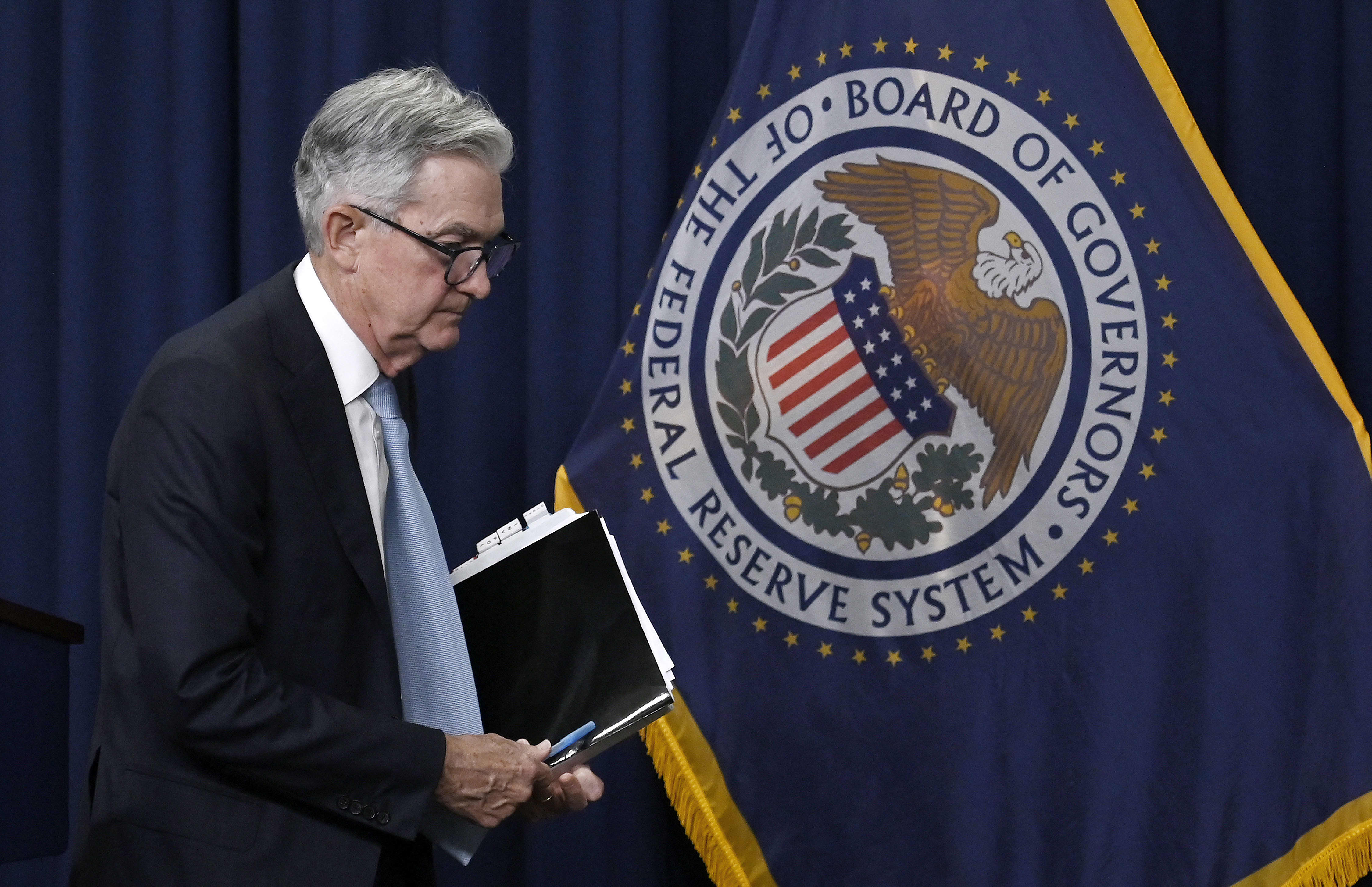
Federal Reserve Chair Jerome Powell.
Xinhua News Agency | Xinhua News Agency | Getty Images

The central bank on Wednesday raised benchmark interest rates by three-quarters of a percentage point to a range of 1.5%-1.75%, the most aggressive hike since 1994.

Powell leaving the door open to another big increase came as a positive surprise to markets as many investors urged the Fed chief to show his seriousness in combating surging prices. Major equity averages jumped to session highs after Powell’s remarks.

Pershing Square’s Bill Ackman said earlier this week that the Fed “has allowed inflation to get out of control. Equity and credit markets have therefore lost confidence in the Fed.”

Ackman called on the central bank to act more aggressively to restore market confidence, saying a series of 1 percentage point hikes would be more efficient in tamping down inflation.

The Fed’s move Wednesday comes with inflation running at its fastest pace in more than 40 years. The Federal Open Market Committee said in a statement that it is “strongly committed” to returning inflation to its 2% objective.

According to the “dot plot” of individual members’ expectations, the Fed’s benchmark rate will end the year at 3.4%, an upward revision of 1.5 percentage points from the March estimate. The committee then sees the rate rising to 3.8% in 2023, a full percentage point higher than what was seen earlier this year.

“We will however make our decisions meeting by meeting and we’ll continue to communicate our thinking as clearly as we can,” Powell said.

Read More

The Federal Reserve raised its target federal funds rate by 0.75 percentage points, the largest increase in nearly three decades, at the end of its two-day meeting Wednesday, in an effort to quell runaway inflation.

“We at the Fed understand the hardship that high inflation is causing,” Federal Reserve Chairman Jerome Powell said in a press briefing Wednesday. “We’re strongly committed to bringing inflation back down and we’re moving expeditiously to do so.”

More from Invest in You:
What new graduates need to know about money and jobs
What Gen Z and millennials want from their employers
Employers boost mental wellness perks amid Great Resignation

The latest move is only one part of a rate-hiking cycle, which aims to crush inflation without tipping the economy into a recession, as some fear could happen. The Fed last raised rates by 75 basis points in November 1994.

“The motivation for all of this is that prices are going up,” said Chester Spatt, a professor of finance at Carnegie Mellon University’s Tepper School of Business. “The Fed is trying to fight that with higher interest rates to reduce demand.”

For consumers, this aggressive approach could eventually bring relief from surging prices. It also comes at a cost.

What the federal funds rate means to you

The federal funds rate, which is set by the central bank, is the interest rate at which banks borrow and lend to one another overnight. Although that’s not the rate consumers pay, the Fed’s moves still affect the borrowing and saving rates consumers see every day.

“We’re certainly going to see the cost of borrowing escalate relatively quickly,” Spatt said.

With the backdrop of rising rates and future economic uncertainty, consumers should be taking specific steps to stabilize their finances — including paying down debt, especially costly credit card and other variable rate debt, and increasing savings, said Greg McBride, chief financial analyst at Bankrate.com.

Pay down high-rate debt

Since most credit cards have a variable interest rate, there’s a direct connection to the Fed’s benchmark, so short-term borrowing rates are already heading higher.

Credit card rates are currently 16.61%, on average, significantly higher than nearly every other consumer loan, and may be closer to 19% by the end of the year — which would be a new record, according to Ted Rossman, a senior industry analyst at CreditCards.com.

If the APR on your credit card rises to 18.61% by the end of 2022, it will cost you another $832 in interest charges over the lifetime of the loan, assuming you made minimum payments on the average $5,525 balance, Rossman calculated.

If you’re carrying a balance, try consolidating and paying off high-interest credit cards with a lower interest home equity loan or personal loan or switch to an interest-free balance transfer credit card, he advised.

Consumers with an adjustable-rate mortgage or home equity lines of credit may also want to switch to a fixed rate, Spatt said. 

Because longer-term 15-year and 30-year mortgage rates are fixed and tied to Treasury yields and the broader economy, those homeowners won’t be immediately impacted by a rate hike.

However, the average interest rate for a 30-year fixed-rate mortgage is also on the rise, reaching 6.28% this week — up more than 3 full percentage points from 3.11% at the end of December.

“Given that they’ve already gone up so dramatically, it’s difficult to say just how much higher mortgage rates will go by year’s end,” said Jacob Channel, senior economic analyst at LendingTree.

On a $300,000 loan, a 30-year, fixed-rate mortgage would cost you about $1,283 a month at a 3.11% rate. If you paid 6.28% instead, that would cost an extra $570 a month or $6,840 more a year and another $205,319 over the lifetime of the loan, according to Grow’s mortgage calculator.

Even though auto loans are fixed, payments are getting bigger because the price for all cars is rising, so if you are planning to finance a new car, you’ll shell out more in the months ahead.

Federal student loan rates are also fixed, so most borrowers won’t be impacted immediately by a rate hike. However, if you have a private loan, those loans may be fixed or have a variable rate tied to the Libor, prime or T-bill rates — which means that as the Fed raises rates, borrowers will likely pay more in interest, although how much more will vary by the benchmark.

That makes this a particularly good time to identify the loans you have outstanding and see if refinancing makes sense.

Hunt for higher savings rates

While the Fed has no direct influence on deposit rates, they tend to be correlated to changes in the target federal funds rate. As a result, the savings account rates at some of the largest retail banks are barely above rock bottom, currently a mere 0.07%, on average.

“The rates paid by bigger banks are largely unchanged, so where you have your savings is really important,” McBride said.

Thanks, in part, to lower overhead expenses, the average online savings account rate is closer to 1%, much higher than the average rate from a traditional, brick-and-mortar bank.

“If you have money sitting in a savings account earning 0.05%, moving that to a savings account paying 1% is an immediate twentyfold increase with further benefits still to come as interest rates rise,” according to McBride.

Top-yielding certificates of deposit, which pay about 1.5%, are even better than a high-yield savings account.

However, because the inflation rate is now higher than all of these rates, any money in savings loses purchasing power over time. 

To that end, “one main opportunity out there is the possibility of buying some I bonds from the U.S. government,” Spatt said. 

These inflation-protected assets, backed by the federal government, are nearly risk-free and pay a 9.62% annual rate through October, the highest yield on record.

Although there are purchase limits and you can’t tap the money for at least one year, you’ll score a much better return than a savings account or a one-year CD.

What’s coming next for interest rates

Consumers should prepare for even higher interest rates in the coming months.

Even though the Fed has already raised rates multiple times this year, more hikes are on the horizon as the central bank grapples with inflation.

While expectations for those increases had been quarter and half-point hikes at each meeting, the central bank could hand out further 50 or 75 basis point increases if inflation doesn’t start to cool down.

Subscribe to CNBC on YouTube.

Read More

As a former Division I softball player, captain of multiple USA Women’s Rugby Teams, and an elite Aquabike athlete for Team USA, I’ve experienced more bumps, bruises, and concussions than I can remember. But that doesn’t compare to the challenges I encountered while bringing to life my vision: a revolutionary toy that celebrates girls’ and […]

The post It’s Imperative That Women Take the Field And Find Success first appeared on Addicted 2 Success.

The post It’s Imperative That Women Take the Field And Find Success appeared first on Addicted 2 Success.

Read More