The exterior of the Marriner S. Eccles Federal Reserve Board Building is seen in Washington, D.C., June 14, 2022.
Sarah Silbiger | Reuters
After years of being a beacon for financial markets, the Federal Reserve suddenly finds itself second-guessed as it tries to navigate the economy through a wicked bout of inflation and away from ever-darkening recession clouds.
Complaints around the Fed have a familiar tone, with economists, market strategists and business leaders weighing in on what they feel is a series of policy mistakes.
Essentially, the complaints center on three themes for actions past, present and future: That the Fed didn’t act quickly enough to tame inflation, that it isn’t acting aggressively enough now even with a series of rate increases, and that it should have been better at seeing the current crisis coming.
“They should have known inflation was broadening and becoming more entrenched,” said Quincy Krosby, chief equity strategist at LPL Financial. “Why haven’t you seen this coming? This shouldn’t have been a shock. That, I think is a concern. I don’t know if it’s as stark a concern as ‘the emperor has no clothes.’ But it’s the man in the street vs. the PhDs.”
Consumers in fact had been expressing worries over price increases well before the Fed started raising rates. The Fed, however, stuck to its “transitory” script on inflation for months before finally enacting a meager quarter-point rate hike in March.
Then things accelerated suddenly earlier this week, when word leaked out that policymakers were getting more serious.
‘Just doesn’t add up’
The path to the three-quarter-point increase Wednesday was a peculiar one, particularly for a central bank that prides itself on clear communication.
After officials for weeks had insisted that hiking 75 basis points was not on the table, a Wall Street Journal report Monday afternoon, with little sourcing, said that it was likely more aggressive action was coming than the planned 50-basis-point move. The report was followed with similar accounts from CNBC and other outlets. (A basis point is one-one hundredth of 1 percentage point.)
Ostensibly, the move came about following a consumer sentiment survey Friday showing that expectations were ramping up for longer-run inflation. That followed a report that the consumer price index in May gained 8.6% over the past year, higher than Wall Street expectations.
Addressing the notion that the Fed should have been more prescient about inflation, Krosby said it’s hard to believe the data points could have caught the central bankers so off guard.
“You come to something that just doesn’t add up, that they didn’t see this before the blackout,” she said, referring to the period before Federal Open Market Committee meetings when members are prohibited from addressing the public.
“You could applaud them for moving quickly, not waiting six weeks [until the next meeting]. But then you go back to, if it was that dire that you couldn’t wait six weeks, how is it that you didn’t see it before Friday?” Krosby added. “That’s the market’s assessment at this point.”
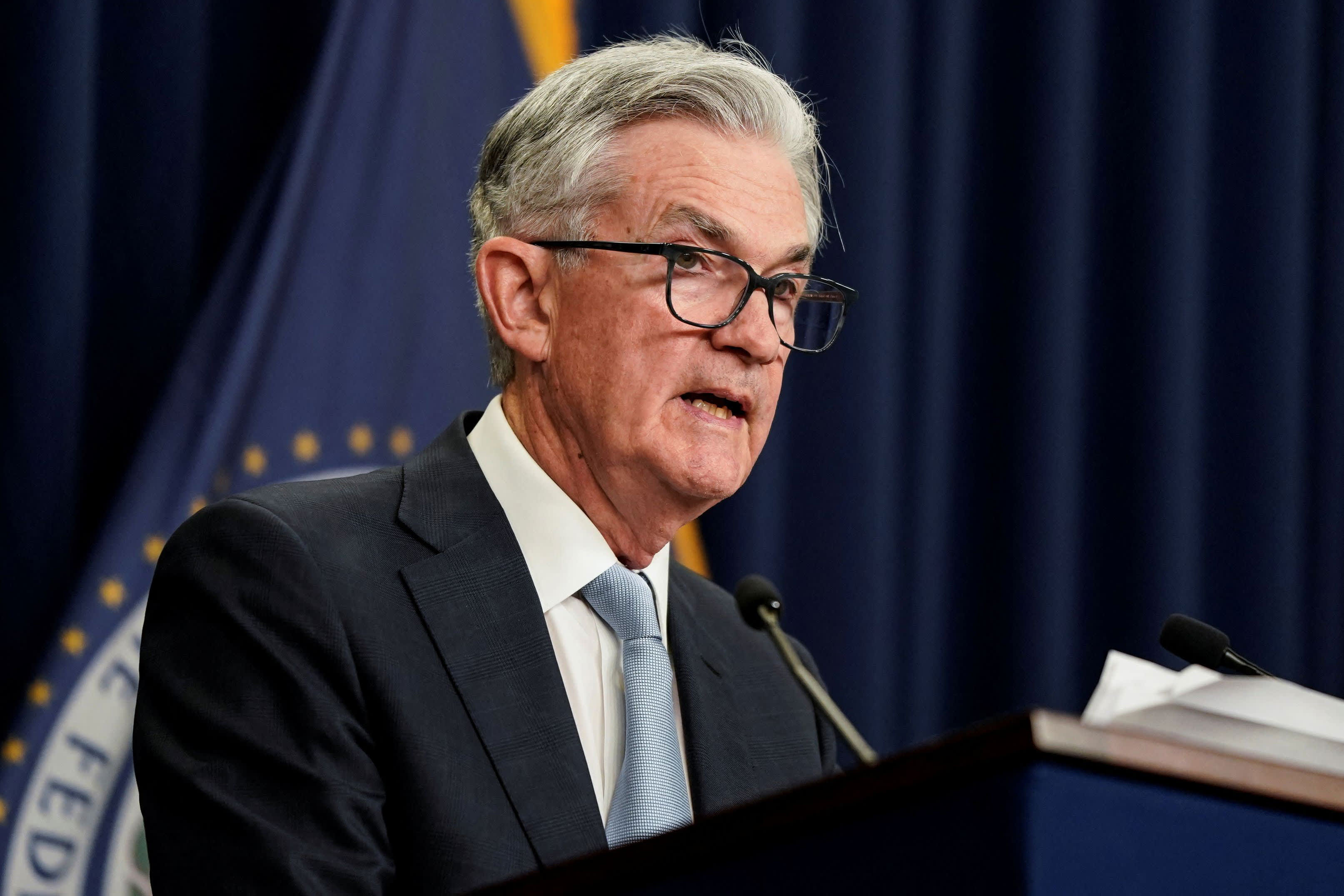
Fed Chair Jerome Powell did himself no favors at Wednesday’s news conference when he insisted that there is “no sign of a broader slowdown that I can see in the economy.”
On Friday, a New York Fed economic model in fact pointed to elevated inflation of 3.8% in 2022 and negative GDP growth in both 2022 and 2023, respectively at minus-0.6% and minus-0.5%.
The market did not look kindly on the Fed’s actions, with the Dow Jones Industrial Average losing 4.8% for the week to fall below 30,000 for the first time since January 2021 and wiping out all the gains achieved since President Joe Biden took office.
Why the market moves in a particular way in a particular week is generally anybody’s guess. But at least some of the damage seems to have come from impatience with the Fed.
The need to be bold
Though the 75 basis point move was the biggest one-meeting increase since 1994, there’s a feeling among investors and business leaders that the approach still smacks of incrementalism.
After all, bond markets already have priced in hundreds of basis points of Fed tightening, with the 2-year yield rising about 2.4 percentage points to around its highest level since 2007. The fed funds rate, by contrast, is still only in a range between 1.5% and 1.75%, well behind even the six-month Treasury bill.
So why not just go big?
“The Fed is going to have to raise rates much higher than they are now,” said Lewis Black, CEO of Almonty Industries, a Toronto-based global miner of tungsten, a heavy metal used in a multitude of products. “They’re going to have to start getting up into the high single digits to nip this in the bud, because if they don’t, if this gets hold, really gets hold, it’s going to be very problematic, especially for those with the least.”
Black sees inflation’s impact up close, beyond what it will cost his business for capital.
He expects the workers in his mines, based largely in Spain, Portugal and South Korea, to start demanding more money. That’s because many of them took advantage of easily accessed mortgages in Europe and now will have higher housing costs as well as sharp increases in the daily cost of living.
In retrospect, Black thinks the Fed should have started hiking last summer. But he sees pointing fingers as useless at this point.
“Ultimately, we should stop looking for who is to blame. There was no choice. This was the best strategy they thought they had to deal with Covid,” he said. “They know what has to be done. I don’t think you can possibly say with the amount of money in circulation that they can just say, ‘let’s raise 75 basis points and see what happens.’ That’s not going to be sufficient, that’s not going to slow it down. What you need now is to avoid recession.”
What happens now
Powell has repeatedly said he thinks the Fed can manage its way through the minefield, notably quipping in May that he thinks the economy can have a “soft or softish” landing.
But with GDP teetering on a second consecutive quarter of negative growth, the market is having its doubts, and there’s some feeling the Fed should just acknowledge the painful path ahead.
“Since we’re already in recession, the Fed might as well go for broke and give up on the soft landing. I think that’s what investors are expecting now for the short term,” said Mitchell Goldberg, president of ClientFirst Strategy.
“We could argue that the Fed went too far. We could argue that too much money was handed out. It is what it is, and now we have to correct it. We have to look forward now,” he added. “The Fed is way behind the inflation curve. They have to move quickly and they have to move aggressively, and that’s what they’re doing.”
While the S&P 500 and Nasdaq are in bear markets — down more than 20% from their last highs — Goldberg said investors shouldn’t despair too much.
He said the current market run will end, and investors who keep their heads and stick to their longer-term goals will recover.
“People just had this sense of invincibility, that the Fed would come to the rescue,” Goldberg said. “Every new bear market and recession seems like the worst one ever in history and that things will never be good again. Then we climb out of each one with a new set of stock market winners and a new set of winning sectors in the economy. It always happens.”